Who stays on the voter list: India's Special Intensive Revisionकिसका नाम रहेगा, किसका कटेगा
A record of the Special Intensive Revision: the first roll of 1951-52, the Bihar order of June 2025, the documents voters were asked to show, the names cut across the country, the officers who did the work, the appeals still waiting, and the dispute inside the Commission. Kept by the editors.
It is undisputed that, prior to the commencement of the SIR, the electoral roll as on 24.06.2025 featured about 7.89 crore electors. Consequently, nearly 65 lakh electors stood excluded from the draft roll for non-submission of the Enumeration Form.
Supreme Court of India, Association for Democratic Reforms & Ors. v. Election Commission of India & Ors., 27 May 2026, paragraph 10.
The Special Intensive Revision, or SIR, is the Election Commission’s rebuilding of India’s , the lists of people registered to vote in each constituency. Booth officers were to hand every voter on the roll a pre-filled enumeration form to fill in and return, and voters who could not be linked to the roll of the last intensive revision could be asked for documents. It began in Bihar in June 2025, and by September 2026 it had cut 13.37 crore names from draft rolls, the lists published for claims and objections before the final roll, in 30 states and union territories: 14.1% of the rolls as they stood before.
Most of those names were not people the Commission found to be dead or listed twice. Of nearly 13.3 crore names deleted, around 9.5 crore, over 71%, were marked ‘absent, shifted, and others’, around 2.7 crore were deaths, and about 1.01 crore were flagged as multiple entries. Many of the first group could still come back, on the form a new voter fills.
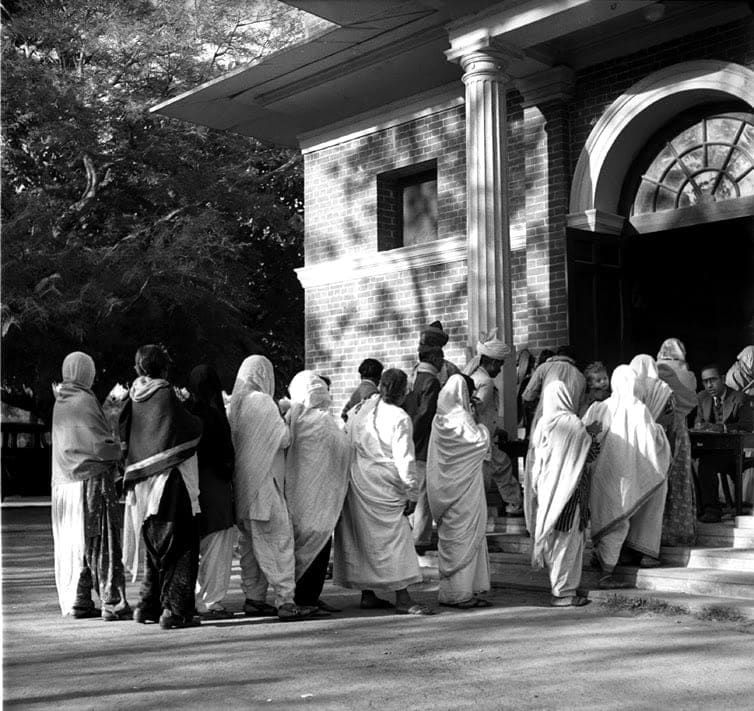
The first roll.India has had to make this list before, and its first one shows how much a list can leave out.Sukumar Sen, the first chief election commissioner, had to register an electorate most of whom could not read or write: universal adult suffrage made 173 million people over 21 eligible, and 85% of them could not read or write. The roll for the general elections of 1951-52 held 17,32,13,635 voters outside Jammu and Kashmir. Nearly 28 lakh women had their entries deleted because they would not give their own names, after the Commission directed that ‘any woman who refused to give her proper name should not be registered as a voter’. Ornit Shani, who teaches Asian studies at the University of Haifa, found that, with citizenship itself still undecided, ‘the most concrete way of being an Indian was to be on the electoral roll’.
How the list is kept.After that first election the Commission ordered intensive revisions, which rebuild the roll from a house-to-house count. Bihar’s last was in 2003; in between, summary revisions publish the existing roll as a draft for claims and objections. Those rolls had real faults: a Janaagraha survey before Delhi’s 2013 election found close to 20% of the city’s names could have serious errors. Canada and Australia keep theirs from records the state already holds, and Australia’s roll covers 97.6% of eligible voters.
Bihar first.Bihar went first. The Commission’s order of 24 June 2025 sent , the local officials who keep the roll of a polling station, to every household with a form for each voter, and a voter whose form was not in by 25 July would not be on the draft roll. A voter on the 2003 roll needed only an extract of it, which officers were to treat as ‘probative evidence of eligibility, including presumption of citizenship’ unless other information came to them.
Nearly 65 lakh of Bihar’s 7.89 crore electors were left off the draft roll of 1 August 2025, and the final roll of 30 September held 7.42 crore.More women than men were removed: Scroll found the electorate had 914 women for every thousand men in January 2025 and 894 afterwards, below the 2011 census ratio of 918, and that nearly 59% of the deleted voters were women. Newslaundry found 11.6 lakh women struck off as dead, though men are nearly 60% of the deaths Bihar records. The Commission told the Supreme Court that women had moved away on marriage; The Hindu said its data showed more men migrating for work than women for marriage.
Analyses of whether the deletions changed Bihar’s election disagree.Scroll found nothing significant in the Commission’s poll data: the National Democratic Alliance won exactly 50% of the close contests. The Wire counted 11 seats where the voters removed before the election outnumbered the winner’s margin.
The documents test.For voters who could not be linked to the old roll, the revision became a test of papers.The list of acceptable documents ran from a birth certificate to a forest rights certificate, and on 8 September 2025 the Supreme Court added Aadhaar as the twelfth, as proof of identity though not of citizenship. Many voters may never have been issued a birth certificate: the Registrar General estimates that only 56.0% of births in Bihar were registered in 2011, and 55.2% in 2016. Writing in The Wire for the Congress, Syed Khalid Saifullah called it unjust to ask for ‘a document that was never issued to them’.
Critics said this moved a test of citizenship onto voters, and India had seen such tests before. Rangarajan R., a former civil servant, wrote that ‘The ECI is not the authority under law to establish the citizenship of any person’. In 1995 the Supreme Court quashed a drive in which the Bombay police had written to 1.67 lakh people asking for documents, and ruled that a name already on the roll carries weight. In Assam, a check of documents for the National Register of Citizens left 19,06,657 people out of it in 2019.
On 27 May 2026 the Supreme Court upheld the Bihar revision. It held that the Commission may enquire into citizenship to decide who goes on the roll, but that only the authority under the Citizenship Act can decide whether a person is a citizen, and that the Commission’s view ‘cannot assume finality on the question of citizenship’. It accepted the Commission’s reasons, that ‘rapid urbanisation and migration’ since 2003 had left ‘repeated, multiple and defective entries’ on the roll. V. Venkatesan of the Supreme Court Observer argued that it distinguished the 1995 ruling although that case, in his reading, concerned the same kind of exercise.
In most of the states it analysed, The Hindu found, the number of women for every thousand men fell between the 2024 Lok Sabha rolls and the final rolls; Tamil Nadu was the only major state where it rose. In Uttar Pradesh 1.55 crore women and 1.34 crore men were cut from the draft roll. West Bengal’s final roll of February 2026 held 6.44 crore names, with another 60.06 lakh doubtful and pending cases marked ‘Under Adjudication’, to be added only if judicial officers approved them.
Analyses and reporting describe the revision falling harder on some groups, though they measure different things. In Bihar, The Wire found voters with Muslim-sounding names were 24.7% of those flagged but 32.1% of those finally removed. A jury convened by the People’s Union for Civil Liberties and two other groups found the revision fell hardest on migrants, Muslims, tribal people and women. In Bengal, Al Jazeera met people struck off although their documents were in order.
Some officers died during the work, and unions and political parties blamed it.Mukesh Jangid, a teacher and booth-level officer in Jaipur, died by suicide in November 2025 after leaving a note that blamed the work and his supervisor’s threats of suspension. In Kerala, booth-level officers struck for a day after the death of Aneesh George; the district collector said no link to the revision had been shown.
The Commission points to its safeguards: in Bihar, it said, no name could be deleted from the draft roll without notice and a speaking order, a decision giving reasons, with appeals to the District Magistrate and then the Chief Electoral Officer. Its letter of 14 May 2026 told officers to hold an inquiry and give a fair and reasonable opportunity before deleting any entry.
Inside the Commission.The revision has also divided the Commission. Two of its three members, Sukhbir Singh Sandhu and Vivek Joshi, recorded at least 14 objections in 10 months, The Indian Express reported, among them a changed form for new voters and appeals in West Bengal. They objected on file to a declaration added to Form 6 asking whether the applicant’s, a parent’s or a grandparent’s name was on the roll of the last intensive revision, and Sandhu called the change ‘unauthorised/ illegal’. Each also wrote to the Cabinet Secretary that central control of who may use the Commission’s software was curbing the powers the law gives roll officers.
The record does not yet show how many of the names cut from draft rolls will be back on the final rolls, or how many of those marked dead were alive. Nor does it show how many people the Commission has referred to the authorities under the Citizenship Act, as the Supreme Court required.॥
Words used here
Words underlined with dots above open their explanation. All of them are here.
Electoral roll The official list of people registered to vote, kept polling booth by polling booth; only someone whose name is on it can vote there.
The official list of people registered to vote, kept polling booth by polling booth; only someone whose name is on it can vote there.
How it is worked out
Each constituency's roll is kept by its electoral registration officer, an officer of the state government, and is revised every year. A revision is published first as a draft, so that anyone can claim a missing name (on Form 6) or object to a wrong one (on Form 7) before the final roll is printed.
For example
A booth with 1,000 names on last year's roll might add 30 young people who have turned 18, take off 15 who died and 10 who moved away, and so begin the new year with 1,005.
Read with care
A name missing from a draft roll is not yet a lost vote: the person can still claim it before the final roll. And a shrinking roll is not by itself proof of wrongful removal, because a roll that never drops the dead and the departed grows too large. What matters is who was removed, and why.
Special Intensive Revision SIR The Election Commission's rebuilding of the voter list from scratch, begun in 2025, in which every voter had to fill in a form again, and some had to show documents, to stay on it.
The Election Commission's rebuilding of the voter list from scratch, begun in 2025, in which every voter had to fill in a form again, and some had to show documents, to stay on it.
How it is worked out
Booth-level officers took a pre-filled form to every voter on the roll. A voter whose form did not come back was left out of the draft roll. A voter who could be linked, by their own name or a parent's, to the roll of the last intensive revision (2003 in Bihar) was taken to be eligible; others could be asked for a document such as a birth or school certificate. Claims, objections and hearings followed, and then the final roll.
For example
Take a booth of 1,000 voters. If forms come back from 900, the draft roll has 900 names. If 600 of those can be matched to the old roll, the other 300 may get a notice asking for a document, and some of the 100 left out may claim their way back in.
Read with care
An ordinary revision adds and removes names on an existing roll; an intensive one starts again, so the work of staying on falls on the voter. Names left off the draft, names deleted from the final roll and appeals are different stages: their numbers should never be added together or taken for one another.
Booth-level officer BLO The local government worker, often a schoolteacher or an anganwadi worker, who keeps the voter list of one polling booth and visits its homes.
The local government worker, often a schoolteacher or an anganwadi worker, who keeps the voter list of one polling booth and visits its homes.
How it is worked out
Each booth-level officer looks after the roll of one booth, under the constituency's electoral registration officer. In a revision they go house to house to hand out and collect forms, note who has died, moved or cannot be found, and check the claims and objections people file. The work comes on top of their own job, for a small yearly payment.
Read with care
A booth-level officer's note that someone is "shifted" or "absent" can be enough to keep a name off a draft roll, so a revision is only as careful as the time these workers have and the way they are supervised. During the national SIR many said the deadlines were impossible; some died, and their families blamed the work.
Form 7 The application to object to a name on the voter list, or to ask for a name to be removed, because the person has died, moved, is listed twice or is not eligible.
The application to object to a name on the voter list, or to ask for a name to be removed, because the person has died, moved, is listed twice or is not eligible.
How it is worked out
Only someone already on the roll of that constituency may file it, against a name in the same roll, giving the reason. The electoral registration officer must check the objection, usually through the booth-level officer, and give the person named a chance to be heard before removing them.
Read with care
A Form 7 is a request, not a deletion. But objections filed in bulk against a neighbourhood or a community still put the people named to the trouble of answering notices to stay on the roll, and they can be lost if they do not.
Unmapped voter A voter whom the SIR could not link, by their own name or a parent's, to the roll of the last intensive revision; such a voter may be sent a notice to show documents.
A voter whom the SIR could not link, by their own name or a parent's, to the roll of the last intensive revision; such a voter may be sent a notice to show documents.
How it is worked out
Officials try to match each returned form to the old roll by name, a relative's name, age and address. Where no match is found, the voter is "unmapped". Where a match is found but the details do not fit together, such as an unlikely gap between a parent's age and a child's, the entry is flagged as a "logical discrepancy". Both can lead to a notice and a hearing.
Read with care
Being unmapped says nothing by itself about whether a person may vote. Names spelled differently, villages renamed, women who moved home at marriage, and adults who were never on the roll two decades ago all fail to match.
The official list of people registered to vote, kept polling booth by polling booth; only someone whose name is on it can vote there.
How it is worked out
Each constituency's roll is kept by its electoral registration officer, an officer of the state government, and is revised every year. A revision is published first as a draft, so that anyone can claim a missing name (on Form 6) or object to a wrong one (on Form 7) before the final roll is printed.
For example
A booth with 1,000 names on last year's roll might add 30 young people who have turned 18, take off 15 who died and 10 who moved away, and so begin the new year with 1,005.
Read with care
A name missing from a draft roll is not yet a lost vote: the person can still claim it before the final roll. And a shrinking roll is not by itself proof of wrongful removal, because a roll that never drops the dead and the departed grows too large. What matters is who was removed, and why.
The Election Commission's rebuilding of the voter list from scratch, begun in 2025, in which every voter had to fill in a form again, and some had to show documents, to stay on it.
How it is worked out
Booth-level officers took a pre-filled form to every voter on the roll. A voter whose form did not come back was left out of the draft roll. A voter who could be linked, by their own name or a parent's, to the roll of the last intensive revision (2003 in Bihar) was taken to be eligible; others could be asked for a document such as a birth or school certificate. Claims, objections and hearings followed, and then the final roll.
For example
Take a booth of 1,000 voters. If forms come back from 900, the draft roll has 900 names. If 600 of those can be matched to the old roll, the other 300 may get a notice asking for a document, and some of the 100 left out may claim their way back in.
Read with care
An ordinary revision adds and removes names on an existing roll; an intensive one starts again, so the work of staying on falls on the voter. Names left off the draft, names deleted from the final roll and appeals are different stages: their numbers should never be added together or taken for one another.
The local government worker, often a schoolteacher or an anganwadi worker, who keeps the voter list of one polling booth and visits its homes.
How it is worked out
Each booth-level officer looks after the roll of one booth, under the constituency's electoral registration officer. In a revision they go house to house to hand out and collect forms, note who has died, moved or cannot be found, and check the claims and objections people file. The work comes on top of their own job, for a small yearly payment.
Read with care
A booth-level officer's note that someone is "shifted" or "absent" can be enough to keep a name off a draft roll, so a revision is only as careful as the time these workers have and the way they are supervised. During the national SIR many said the deadlines were impossible; some died, and their families blamed the work.
The application to object to a name on the voter list, or to ask for a name to be removed, because the person has died, moved, is listed twice or is not eligible.
How it is worked out
Only someone already on the roll of that constituency may file it, against a name in the same roll, giving the reason. The electoral registration officer must check the objection, usually through the booth-level officer, and give the person named a chance to be heard before removing them.
Read with care
A Form 7 is a request, not a deletion. But objections filed in bulk against a neighbourhood or a community still put the people named to the trouble of answering notices to stay on the roll, and they can be lost if they do not.
The Election Commission of India began a Special Intensive Revision of Bihar’s electoral roll on 25 June 2025, sending an enumeration form to each of the 8 crore voters on it.
Supreme Court judgment, 2026. Supreme Court of India
The Supreme Court’s judgment on the Special Intensive Revision of Bihar’s electoral roll, in which voters had to return an enumeration form to stay on the draft roll.
The Election Commission’s data, reported here, break down the names cut from the electoral rolls in the Special Intensive Revision (SIR) into three groups: the absent, shifted or ‘others’ category, deaths, and multiple entries.
How independent India put 17 crore adults, most of whom could not read, on its first list of voters in 1951-52.
6 entries · 1950–2024
19502026
The Electoral Registration Officers were, therefore, instructed to substitute the women voters’ proper names for their description in such cases. Directions were also issued to the effect that any woman who refused to give her proper name should not be registered as a voter and if she had already been registered without the name, the entry should be deleted.
The Constitution of India as on 1 May 2024, with all amendments up to 2023. It is the frame for this Long View on who stays on India’s voter list. The Election Commission is in charge of preparing the electoral rolls (article 324). One general electoral roll serves each territorial constituency for Parliament or State Legislatures, and no one may be kept off it on grounds only of religion, race, caste or sex (article 325). For the House of the People and State Assemblies, a citizen of at least eighteen years on the date fixed by law, not otherwise disqualified, is entitled to be registered as a voter (article 326). Panchayat and municipal rolls sit with State Election Commissions.
More from this sourceThe figures checked
The 6 figures in the note checked on pp. 308, 326, 432 and 434
.
Google Arts & Culture’s story by Ruchita Bait Gavhane tells how India held its first general election, and counts identifying, naming and registering voters among its great tasks. Universal adult suffrage made 173 million people over 21 eligible to vote, and 85% of them could not read or write; symbols, ballot papers and ballot boxes had to be designed with that in mind. Sukumar Sen, the first Chief Election Commissioner, conducted the election. Polling ran from 25 October 1951 to 21 February 1952. 45.7% of eligible voters turned out. The Indian National Congress won 364 of the 489 seats, and Jawaharlal Nehru became the first elected prime minister.
Report on the First General Elections in India 1951-52, Volume I (General)
By Sukumar Sen
This is the Election Commission’s own report on the first general elections, signed by the Chief Election Commissioner, Sukumar Sen. It records how the first electoral roll was built, how the Commission planned later revisions, and that women who would not give their own names had their entries deleted. It admits the rolls were not accurate, and says a house-to-house check of one-fifth of each state every year would cover every part in five years.
More from this sourceWhat it found and the figures checked
What it found
The Commission enrolled about 17.3 crore voters in the first electoral roll outside Jammu and Kashmir. About 70 lakh adults were left out, some of whom may not have had the necessary qualifications.p. 75
The Commission accepted that its final rolls were not as accurate as it wished, and that many eligible electors were missing from them.p. 75
Nearly 28 lakh women voters had their entries deleted for not disclosing their own names, almost all of them in Bihar, Uttar Pradesh, Madhya Bharat, Rajasthan and Vindhya Pradesh.p. 79
After the first elections the Commission ordered intensive revisions, each part of the rolls to be checked by house-to-house enquiry at least once in five years.p. 81
Across the country, 16,58,428 claims to add a name and 7,31,750 objections were filed against the draft rolls, and the authorities allowed 13,93,526 claims and 7,12,802 objections.p. 74
The 2 figures in the note checked on pp. 81 and 82
.
The Travails of India’s first election commissioner
By Ramachandra Guha
This article, an extract from Ramachandra Guha’s India after Gandhi, follows Sukumar Sen, the mathematician and civil servant appointed India’s first chief election commissioner in March 1950. His task was to register an electorate in which most people could not read or write, and Sen asked Jawaharlal Nehru to wait. The polls were set for early 1952, with a few far-off districts voting sooner. It shows what it took to put every adult’s name on a list.
…the diffidence of many women in northern India to give their own names, instead of which they wished to register themselves as A’s mother or B’s wife. … Nonetheless, some 2.8 million women voters had finally to be struck off the list. The resulting furore over their omission was considered by Sen to be a ‘good thing’, for it might help the prejudice vanish before the next elections, by which time the women could be reinstated under their own names.
Ornit Shani teaches Asian studies at the University of Haifa, and her book How India Became Democratic traces how India prepared its first list of voters, a subject this Long View follows. In an interview with The Wire, she says election officials could not answer her, and that the files she needed turned up in the Election Commission’s record room, now in the National Archives. With citizenship still undecided, a place on that roll became the clearest proof of being Indian, and refugees fought for one.
The criteria for registration on the roll were seemingly simple. A person had to be a citizen, and to reside in the place of registration for a minimum of 180 days. But the question “who is an Indian”, who was a citizen at the time, was undecided and a very contested question. … In effect, the most concrete way of being an Indian was to be on the electoral roll.
An episode of Samvidhaani Pitaara, the Radio Azim Premji University series on the Constitution. Hosts Seetal and Vineet KKN Panchhi retell, as a dramatised radio broadcast, the counting in 1952 that declared independent India’s first general election results. It is the election the first roll made possible, told for a general listener.
The law on who may be on the roll, how rolls are revised, and the faults they carried before 2025.
8 entries · 1950–2026
19502026
195012 May
Act
The Representation of the People Act, 1950
Act 43 of 1950
The Act that governs who is on India’s voter list, and how the list is prepared and revised. It puts electoral-roll preparation and revision under the Election Commission’s superintendence, direction and control, and names the officers in charge, down to the electoral registration officer of each constituency. It sets out when a name is corrected, shifted or deleted, and how someone left off can get back on. Civil courts cannot decide whether someone is entitled to be registered on a constituency’s electoral roll, or question the specified official actions and decisions about that roll.
The Election Commission published this handbook in 2011 for its booth level officers. They are local government or semi-government officials who keep the voters’ list for one or two polling station areas, and find dead, shifted and duplicate names. It names four kinds of revision, among them the two that matter here. An intensive revision builds the roll afresh from a house-to-house count. A summary revision, normally held every year, publishes the existing roll as a draft for claims and objections. It also states the safeguard that matters when names are struck: no name is removed for residence alone without the due procedure, which includes a duly filled Form 7 objection.
The BLO will make a thorough study of the roll of the part assigned to him. He will make frequent field visits to the villages/Tolas in the said part and interact with local people particularly village elders and grass root level elected representatives and identify the names of the dead/shifted/duplicate voters in the roll, which need to be removed by the ERO under relevant provisions of law.
In an intensive revision, draft rolls are prepared from the house-to-house count and published for claims and objections before the final roll.p. 18
The handbook says a name cannot be struck off for not living in the area unless the procedure is followed, and that the procedure includes a duly filled objection in Form 7.p. 41
Proof of residence can be the latest water, telephone, electricity or gas connection bill for the address, and it may be in the applicant's name or that of an immediate relation, such as a parent.p. 23
The booth level officer is a local government official, usually a voter of the same area, and the job can go to a teacher, anganwadi worker, patwari or postman.p. 4
Between revisions the roll is updated through the year, but that stops from the last day of nominations until the election ends.p. 24
Janaagraha, a Bangalore non-profit that works on city voter rolls, checked a sample of names on Delhi’s list just before the 2013 assembly election. Close to 20% of the names could have serious errors that called for deletion, the survey found, because the voter had died, moved away or could not be traced. The study came after the Election Commission had reportedly removed 14 lakh names from Delhi’s rolls. In six of the seven constituencies surveyed, the number of doubtful names was larger than the winning margin in 2008. The article argues that an inflated roll makes fraud easier and makes city turnout look lower than it was.
The Delhi PURE List survey, conducted in the run-up to the assembly election, found that close to 20% of the names appearing on Delhi’s voter lists could have serious errors, requiring these names to be deleted either because the voter had died, shifted, or could not be found. … In Burari AC, when the number of names to be deleted was over 45,000, the margin of victory was 4990 votes.
Note explaining process of annual revision/updation of Electoral Rolls along with Frequently Asked Questions (FAQs)
The Election Commission’s own account of how it revises India’s voter list, with answers to the questions it is asked about the process. It describes house-to-house checking by booth level officers, the draft roll, and the public lists of claims and objections. Its safeguards against wrongful deletion include a personal notice and a reasonable opportunity for a hearing in proposed deletions other than death cases. It is the Commission’s own account of its process.
The Commission ensures utmost transparency at each stage of revision of roll so that people can beforehand check entries in electoral roll and can file any claim or objection, to avoid any post facto objection or grievances. In case of deletion, notice is issued and an opportunity given to electors for filing an objection and hearing is given.
Field verification is checked in layers: a supervisor with about ten booth level officers rechecks 5% of each officer's work, and the assistant electoral registration officer above him rechecks 1%.p. 9
Where removals pass 2% of the electors in an area, or one person objects to more than five cases, the registration officer personally verifies the deletions.p. 6
A decision to delete waits at least seven clear days after the lists are published and given to political parties, and, except for deaths, until a personal notice has been served on the person named.p. 5
A 2021 amendment gave the year four qualifying dates, 1 January, 1 April, 1 July and 1 October. An eligible citizen who turns eighteen on one of them may apply in advance on Form 6 from the draft publication of the roll, and the application is processed in that quarter.p. 11
A polling station holds no more than 1,500 voters, on average about 200 to 250 households, and a booth level officer who knows the area makes the field checks and collects enrolment forms.p. 7
An identical EPIC number does not make two voters in different states duplicates or fakes, the Election Commission said on 2 March 2025. The Commission blamed a manual, decentralized system for the overlap, and said some state offices had used the same series of letters and digits before the rolls of all states moved to the ERONET platform. It said it would give every registered elector a unique number, fix any duplicates, and update the ERONET 2.0 platform to help.
Towards Automatic Voter Registration: Lessons from Canada and Australia
By Sonali Campion, Toby S. James and Holly Ann Garnett
A report for the UK Democracy Fund on how Canada and Australia keep their voter registers from records the state already holds. Canada draws on about 40 federal and provincial sources, Australia on tax, immigration, driver and birth records, and neither has one master list of residents to work from. The report puts Australia’s roll at 97.6% of eligible voters, against 90.9% at the 2010 election, and Canada’s coverage at 96.2% in 2025.
The two countries show that even in the absence of a single population register, the completeness and accuracy of the register can be improved. They highlight that there are advantages of combining assisted forms of enrolment … with automated systems to ensure the register is effectively maintained. This combined approach could work well in the UK, reducing the risk of disenfranchisement that might be associated with moving directly to a fully automated system.
More from this sourceWhat it found and the figures checked
What it found
Australia's electoral roll reached 97.6% of eligible voters after the law let officials add and update enrolments from other agencies' records, against 90.9% in 2010.p. 4
Canada's permanent register replaced door-to-door canvassing and has kept coverage at 92% or higher for two decades, reaching 96.2% in 2025.p. 5
A Canadian driver's licence can update an existing entry but cannot create one, because a licence says nothing about citizenship, so the elector must attest to that themselves.p. 12
The Australian system works at a scale of millions: in 2024 it loaded 6.8 million records, sent 1.3 million letters, and made about 290,000 direct enrolments or re-enrolments and a million direct updates.p. 15
Australia has no register of citizens, so the Australian Electoral Commission checks eligibility against passport, citizenship and birth records and works with Services Australia for people who may not appear in those records, most notably Indigenous Australians.p. 16
The 4 figures in the note checked on pp. 4, 5 and 9
.
Beyond ‘Special’: How the 2025 Bihar SIR marks a break from the past
By Debjani M
This analysis of the Election Commission’s ‘special intensive revision’ of Bihar’s voter rolls was published as the Supreme Court considered its verdict on the challenge to the exercise. The Commission cited urban growth, migration, unreported deaths and the removal of people it calls ‘illegal immigrants’, and says the ‘special’ label falls within its powers. The article traces the long history of roll revision and argues the Bihar exercise departs from the rule that a voter is presumed to stay enrolled.
In marked contrast to the 2025 Bihar SIR, earlier revisions operated on a presumption in favour of preserving the sanctity of the electoral roll. The burden lay on the objector, not the voter. … But the latest SIR charts a different course: it shifts the burden of proof onto electors, dispenses with prior house-to-house verification, compresses the window for appeal and proceeds with a de novo exercise that sidelines prior rolls.
T N Seshan, N Gopalaswami, Ashok Lavasa: When Election Commission members differed
By Damini Nath
This explainer from The Indian Express is about disagreement inside the three-member Election Commission of India, where the majority view decides a matter when the members differ. It follows the paper’s investigation, published on September 23, which found two commissioners had objected at least 14 times in 10 months, about matters including the commission’s computer systems and the voter enrolment form. The Commission says such observations made during drafting are part of its deliberation, and that its decisions in recent months were unanimous.
Before the Election Commission issued its order starting the Special Intensive Revision of electoral rolls on June 24, 2025, Election Commissioner Sukhbir Singh Sandhu had observed on the draft order that the exercise should not lead to harassment to voters and citizens … “Care should be taken that genuine voters/citizens, particularly old, sick, PwD (persons with disabilities), poor and other vulnerable groups do not feel harassed and are facilitated,” Sandhu had written.
The first revision, from the order of June 2025 to the final roll and the election that followed.
10 entries · 2025
19502026
In January 2025, the gender ratio of the Bihar’s electorate was 914 – that is, for every thousand registered male voters, Bihar had 914 registered female voters. After the SIR, this figure has fallen to 894. This is lower than the state’s gender ratio. According to the 2011 census, Bihar has 918 women for every thousand men. … Nearly 59% of the voters deleted during the SIR are women.
Special Intensive Revision w.r.t. 01.07.2025 as the qualifying date
The Election Commission’s order of 24 June 2025, signed by its Secretary, Pawan Diwan, directed a Special Intensive Revision in Bihar and promised a schedule for the rest of the country later. Booth-level officers were to visit every household and hand each existing voter a pre-filled enumeration form. The schedule listed the collection of forms, with documents, through 26 July 2025. An existing elector whose form was not submitted before 25 July would not be included in the draft roll. A voter on the 2003 roll needed no document beyond an extract of that roll. Electoral registration officers were to treat it as evidence of eligibility, including a presumption of citizenship, unless other information came to them.
Association for Democratic Reforms & Ors. v. Election Commission of India
W.P.(C) No. 640/2025
Held. The court issued notice in the petitions, returnable on 28 July 2025, and told the Election Commission to file its counter affidavit by 21 July. It named three questions for hearing, on the Commission’s power, its procedure and its timetable, and asked it to consider Aadhaar, the electors’ photo identity card and the ration card when verifying voters.
Therefore, since the list is not exhaustive, in our opinion, it would be in the interests of justice if the Election Commission of India also considers the following three documents such as 1) Aadhar Card; 2) Electors Photo Identify Card (EPIC), which is issued by Election Commission of India itself, and 3) the Ration Card, as these documents would satisfy most of the voters.
The Supreme Court heard a batch of petitions against the Election Commission’s order of June 2025 for a special intensive revision of the electoral roll. The court called the question one of the right to vote and identified three issues: the Commission’s power to run the exercise, its procedure, and a timetable it said was very short. It gave the Commission a deadline for its reply and fixed the next hearing before the draft roll is published. The court also asked the Commission to consider Aadhaar, the electors’ photo identity card and the ration card when verifying voters.
More from this source3 more passages and the figures checked
The three questions the court framed
After hearing both the sides, prima facie, we are of the opinion that there are following three questions involved in these petitions :a) the very powers of the Election Commission to undertake the exercise; b) the procedure and the manner in which the exercise is being undertaken; and c) the timings, including the timings given for preparation of the Draft Electoral Rolls asking objections of making final Electoral Roll etc., which is very short, considering the fact that Bihar Elections are due in November, 2025 and the Notification will come in advance weeks earlier.
Mr. Rakesh Dwivedi, learned senior counsel representing the Election Commission of India, on the other hand, would argue that the last Intensive Revision of Electoral Rolls took place as far back as in the year 2003 and presently, an intensive revision is required, which is also mandated not only under Article 326 read with Section 21(3) of the Representation of Peoples Act, 1950 and Rules framed therein.
The petitioners are not pressing any interim stay at this stage, as in any case, the Draft Electoral Rolls has to be published only on 01.08.2025 and the matter is listed before this Court prior to that date i.e. on 28.07.2025.
Bihar SIR: Key Findings of Enumeration Phase (24 June-25 July 2025)
By Apurva Kumar Singh
In July 2025 the Election Commission of India issued a press note on Bihar’s Special Intensive Revision. Booth level officers took enumeration forms house to house, and not sending one back by 25 July was among the reasons a form was not received. Of 7.89 crore electors on the roll on 24 June 2025, over 7.24 crore had submitted forms. The Commission says no name can be struck from the draft roll without notice and a speaking order. An aggrieved elector may appeal to the District Magistrate and then the Chief Electoral Officer. Genuine electors left out can seek inclusion during claims and objections from 1 August to 1 September.
As per Para 5(b) of SIR guidelines, NO NAME CAN BE DELETED from the draft list published on 1st August without notice and speaking order of the ERO/AERO. … Any elector aggrieved by any decision of the ERO may appeal to the District Magistrate and the Chief Electoral Officer thereafter under Section 24 of the RP Act, 1950.
More from this sourceWhat it found and the figures checked
What it found
The Commission lists four reasons a booth level officer did not find an elector or did not get back that elector's form. They are: the person registered in another state or union territory, was not found to exist, did not submit the form by 25 July, or was unwilling to register. The Commission says the exact status of these electors would be known after scrutiny by 1 August 2025.p. 1
Electoral registration officers and their assistants will settle the exact status of the electors whose forms did not come back when they scrutinise the forms by 1 August 2025.p. 1
Genuine, eligible electors who were left out can seek inclusion during the claims and objection period from 1 August to 1 September.p. 1
The Commission says an elector found on the rolls in more than one place will keep the name at only one place.p. 1
To reach migrants from Bihar, the Commission placed a full-page Hindi advertisement in 246 newspapers with a combined circulation of nearly 2.60 crore copies.p. 3
The 3 figures in the note checked on pp. 1 and 2
.
'Bihar SIR Is Intensive Deletion Exercise' : Yogendra Yadav Appears In Supreme Court With Two Persons Deleted As Dead By ECI
By Debby Jain
This Live Law report covers a Supreme Court hearing on petitions against the Election Commission’s Special Intensive Revision of Bihar’s electoral rolls. The activist Yogendra Yadav brought two people to court who, he said, had been declared dead in the Commission’s draft roll. He argued the exercise was deleting voters on a scale not seen before. The Commission’s counsel said Yadav could instead help those people get the roll corrected, and called his display drama.
We are witnessing perhaps the largest exercise of disenfranchisement, not in India, in the history of the world. Entire figure will cross 1 crore, if they are serious about what they are doing. We will break record of US in 19th century. This is a tectonic shift in universal adult franchise, because the onus has been shifted from state to the individual
More men die in Bihar, but more women vanish from its voter rolls
By Sumedha Mittal and Vishal Vaibhav
Bihar’s voter rolls lost 65.7 lakh names in one month of the Special Intensive Revision, the Election Commission’s re-check of the state’s voter rolls. Newslaundry reads the Commission’s own breakdown and finds women at 36.59 lakh of the deletions against 29.3 lakh men. Death was given as the reason for 11.6 lakh of those women, though the state’s register of births and deaths records men as nearly 60 percent of deaths between 2018 and 2022.
During just one month of the Special Intensive Revision (SIR) of voter rolls in Bihar, the names of 65.7 lakh electors were struck off the list. Of these, 36.59 lakh were women and 29.3 lakh were men – meaning 7.6 lakh more women than men were deleted. … As per the annual register of births and deaths in Bihar, men account for nearly 60 percent of deaths in the state between 2018 and 2022.
Apurva Kumar Singhon the platform · 30 September 2025
The Election Commission’s press note announcing that the Special Intensive Revision of Bihar’s electoral rolls was finished on 30 September 2025, with about 7.42 crore voters on the final list. It prints the exercise’s numbers and thanks the officials, political parties and Booth Level Officers who did the work. This is the Commission’s own account of what the revision changed in one state’s voter list.
Why exclusion of women voters in Bihar should worry Nitish Kumar
By Ayush Tiwari
Scroll compared Bihar’s voter roll from January 2025 with the final roll published on September 30, after the Election Commission’s special intensive revision, and found women were removed in larger numbers than men. That left the state’s electorate with fewer women per thousand men than the state’s population as a whole. The article says the average fall in the electorate’s gender ratio is greatest in seats won by the Janata Dal (United) in 2020. It says Nitish Kumar’s support among women is thought to have helped the National Democratic Alliance win that election.
The Reporters’ Collective reports that the Election Commission of India did not use its duplicate-checking software during Bihar’s revision of the voter roll. Officials in Delhi and four electoral registration officers in Bihar told its reporters that state teams had no access to it, and that suspect lists were not shared for verification. The article says manual checks at booths were left as the only safeguard, and that Bihar’s chief electoral officer, Vinod Singh Gunjiyal, did not answer emailed questions.
Yet for Bihar’s SIR, a high-stakes 30-day sprint announced with tech-savvy fanfare, ECI sidelined it entirely… The finalised rolls for Bihar’s 243 assembly seats harbour 14.35 lakh suspect duplicates, including 3.4 lakh exact matches across demographics.
Bihar 2025: In 11 Seats, SIR Deletions Outnumbered Victory Margins
By Pavan Korada
The Wire compares the voters taken off Bihar’s rolls in the pre-election special intensive revision with the winner’s margin in each constituency in the 2025 election, and finds seats where the deletions were larger. It keeps the overall shrinkage of the roll, which includes routine removals of people who died, were listed twice or moved away, apart from the deletions made after the draft roll was published. The names removed in that last phase, between the draft roll and the final roll, are the ones the Supreme Court asked about.
A close analysis of the 2025 Bihar assembly election reveals a critical detail: in 11 seats, the number of voters removed from the rolls during the pre-election special intensive revision (SIR) was greater than the winner’s margin of victory.
What Election Commission data says about ‘vote chori’ in the Bihar elections
By Ayush Tiwari
Opposition parties blamed vote chori, or vote theft, for their defeat in the 2025 Bihar Assembly election, and much of their suspicion centred on the Election Commission’s special intensive revision (SIR) of the state’s voter lists. Scroll analysed the commission’s data on the poll for red flags or anomalies, including whether the deletions changed the results, and found nothing significant. In the villages it had visited in the Seemanchal region during the revision, more votes were cast than before and the winners were broadly the same.
The National Democratic Alliance won exactly 50% of the close contests. The Opposition Mahagathbandhan alliance won 46.4% of them and one seat went to the Bahujan Samaj Party, which is not a part of either alliance. … In all, there were 10 seats in Bihar where electors added after SIR exceeded the margin of the winner. Five of these seats were won by the National Democratic Alliance, four by the Mahagathbandhan and one by Bahujan Samaj Party.
What voters were asked to show, who holds such papers, and what the Supreme Court decided.
10 entries · 1995–2026
19502026
Moreover, in cases where the Commission is not satisfied that a person meets the statutory conditions for inclusion in the electoral roll, it would be incumbent upon it to refer such an individual to the competent authority within the Central Government for adjudication in accordance with law. The Commission’s determination, being confined to electoral purposes, cannot assume finality on the question of citizenship.
1995 AIR 1189, 1995 SCC (3) 100, JT 1995 (2) 229, 1995 SCALE (1) 483
Held. The court quashed the proceedings to remove suspected foreigners from the rolls and allowed fresh notices only if they disclosed the material behind the suspicion. It required the inquiry to be quasi-judicial, meaning the officer must weigh all the evidence, disclose the material relied on, and pass a reasoned order, with weight given to the person’s presence on the previous roll.
If the opportunity of being heard before deletion of the name is to be a meaningful and purposive one, it goes without saying that the concerned person whose name is borne on the roll and is intended to be removed must be informed why a suspicion has arisen in regard to his status as a citizen of India so that he may be able to show that the basis for the suspicion is ill founded.
Directives the Election Commission issued in August 1992 and September 1994 told officials to identify voters who were not Indian citizens, and in Bombay the police wrote to 1.67 lakh people asking for documents. The Supreme Court quashed those proceedings in February 1995. It ruled that any further inquiry must disclose the material behind the suspicion, hear all the evidence offered, and end in a reasoned order, with weight given to a name already on the previous roll.
More from this source4 more passages
On asking a new applicant for proof of citizenship
In the first mentioned situation before the name is entered on the rolls, the concerned officer must be satisfied that the person seeking to have his name entered is not disqualified by reason of his not being a citizen of India. Therefore, he would be justified in requiring the concerned person to show evidence that he is a citizen of India.
On the petitioners learning that the revised electoral rolls had been published and out of 18,000 voters registered in the previous electoral rolls … names of only 300 persons figured, thus, leaving out almost 98% of the voters thereby depriving them of their democratic right to elect their representatives.
Even the Electoral Registration Officers merely acted on the police report, copies whereof were admittedly not supplied to the addressees thereby making a mockery of the reasonable opportunity of being heard requirement contemplated under the 1950 Act and the 1960 Rules.
If any person whose citizenship is suspected is shown to have been included in the immediately preceding electoral roll, the Electoral Registration Officer or any other officer inquiring into the matter shall bear in mind that the entire gamut for inclusion of the name in the electoral roll must have been undertaken and hence adequate probative value be attached to that factum before issuance of notice and in subsequent proceedings
Final NRC list in Assam published, over 19 lakh people left out
By TNM Staff
The News Minute’s report of 31 August 2019 covers the final National Register of Citizens for Assam, published that day after an update the Supreme Court ordered and monitored. It gives the government’s figures for who was included and left out, the promised appeal at Foreigners’ Tribunals, and strangers’ objections to names and the opposition’s allegation that most of the excluded were Muslim. It belongs in this Long View as the nearest earlier example of a mass check of documents that decided who stayed on that register.
Taking into account all the persons already included and after disposal of all claims and objections...it has been found that a total of 3,11,21,004 numbers of persons are found eligible for inclusion in the final NRC, leaving out 19,06,657 numbers of persons, including those who did not submit claims, an official release by the government said.
Reporting·Office of the Registrar General, India, Ministry of Home Affairs
Vital Statistics of India Based on the Civil Registration System 2019
By Office of the Registrar General, India
This is the Registrar General’s annual report on India’s civil registration system, the compulsory recording of births and deaths, for 2019. It gives, for each state, the level of birth registration: registered births as a share of the births the Sample Registration System estimates. The report also records an April 2019 circular telling states that Aadhaar need not be treated as compulsory for registering a birth or death.
There is no provision in the RBD Act which permits the use of Aadhaar for establishing the identity of an individual for the purpose of registration of birth and death. In this respect, in order to avoid any inconvenience to the general public, the Chief Registrars of all States/UTs were clarified that the use of Aadhaar number for the purpose of registration of birth and death need not be considered as mandatory requirement …
In Bihar the Registrar General estimates that 56.0% of births were registered in 2011 and 55.2% in 2016, against 82.4% and 84.5% for India as a whole.p. 61
Bihar's level reached 89.3% only in 2019; India's stood at 92.7%.p. 61
Indian missions abroad, which register the births and deaths of citizens under the Citizenship Act, 1955, reported 46,475 births and 7,428 deaths in 2019, from 154 missions in 125 countries.p. 25
The report says its measure of how complete registration is rests on 2018 survey rates, because the survey for 2019, scheduled for 2020, could not be completed amid the COVID-19 pandemic.p. 6
'Election Commission Has Power To Verify Citizenship' : ECI Tells Supreme Court In Bihar SIR Matter
By Amisha Shrivastava
The Election Commission told the Supreme Court it can check whether a person seeking a place on the electoral roll is a citizen, defending the Special Intensive Revision of Bihar’s rolls. The Commission said Article 326 of the Constitution and the Representation of the People Act, 1950 oblige it to keep non-citizens off the roll, and that it does not itself decide citizenship. The Supreme Court had said on July 10, orally, that deciding citizenship was the Union government’s job. The petitions are listed for hearing on July 28.
ECI is vested with the power to scrutinize whether a proposed elector fulfils the criteria for being registered as a voter in the electoral roll, which includes, inter alia, an assessment of citizenship as per Article 326 of the COI. Such scrutiny is constitutionally mandated and crystallized by virtue of RP Act 1950.
Explainer: What is the Special Intensive Revision of Electoral Rolls?
By Rangarajan R.
The Election Commission of India began a Special Intensive Revision of Bihar’s electoral roll on 25 June 2025, sending an enumeration form to each of the 8 crore voters on it. Voters enrolled after January 2003 also had to produce documents showing when and where they and their parents were born. Rangarajan R., a former Indian Administrative Service officer, sets out the law and both sides of the argument, including the objection that the exercise turns the Commission into a verifier of citizenship.
The ECI is not the authority under law to establish the citizenship of any person; this lies with the home ministry. The task of verifying the documents in such a short span to establish the citizenship of voters enrolled after 2003, roughly around 3 crore voters, is of gigantic proportions.
How EC's Ask For Proof of Birth Punishes Bihar's Citizens For State's Historic Low Capacity
By Syed Khalid Saifullah
This opinion piece in The Wire by Syed Khalid Saifullah argues that many voters in Bihar’s special intensive revision of the voter rolls may lack a suitable listed document, often because they were never issued a birth certificate. The writer is vice chairman of the data analytics department of the Indian National Congress, and he calls the aim of clean electoral rolls understandable but the requirement unjust. The article sets out the documents accepted as proof, and notes that claims and objections were to close on 1 September.
This, again, is not because they are not Indian but because they cannot produce a document that was never issued to them. … The EC’s intention to ensure the integrity of the electoral rolls is understandable. But requiring documents that a majority of citizens may never have had access to is not just impractical – it is unjust.
Association for Democratic Reforms & Ors. v. Election Commission of India
W.P.(C) No. 640/2025
Held. The court held that the Aadhaar card must be accepted as proof of identity for adding or removing a name in Bihar’s revised voter list, though it does not prove citizenship. The Election Commission was told to issue its instructions in this regard by 9 September 2025.
There is no quarrel that as per the statutory status assigned to Aadhaar Card under the Aadhaar (Targeted Delivery of Financial and Other Subsidies, Benefits and Services) Act, 2016, it is not a proof of citizenship and therefore shall not be accepted as proof of citizenship. However, keeping in view Section 23(4) of the Representation of People Act, 1950, the Aadhaar Card is one of the documents enumerated for the purpose of establishing the identity of a person.
This Supreme Court order of 8 September 2025 addresses a batch of petitions concerning the revised voter list in Bihar, and does not finally decide them. Justices Surya Kant and Joymalya Bagchi held that the Aadhaar card is not proof of citizenship. The card must still be accepted as proof of identity when a name is added to or removed from the roll, and the Election Commission was told to issue instructions by the next day.
More from this source3 more passages
On the question the bench said it was deciding
The short issue that needs to be further clarified pertains to the acceptability and status of the Aadhaar Card insofar as supporting documents are concerned.
On notice in a connected petition, and the next hearing; an AOR is an advocate-on-record, a lawyer registered with the court
Issue notice in IA No. 218693/2025. Mr. Eklavya Dwivedi, learned AOR accepts notice on behalf of the Election Commission of India. Mr. Arvind Kumar Sharma, learned AOR accepts notice on behalf of Union of India. Reply, if any, be filed before the next date of hearing. List on 15.09.2025.
Explained | List of 12 documents that can be used as proof of nationality as per Bihar SIR
By DH Web Desk
A Deccan Herald explainer on the documents Bihar’s Special Intensive Revision of electoral rolls accepts for voter identity verification. It reports the Supreme Court’s direction to the Election Commission to add Aadhaar as the twelfth document, and the court’s clarification that Aadhaar proves identity and does not confirm citizenship. The piece sets out the accepted documents, among them a birth certificate, a pension order and a forest rights certificate.
The court clarified that the EC must verify the authenticity of Aadhaar numbers submitted by voters and ensure that only legitimate citizens are included in the voter list, while preventing the inclusion of forged or fake entries. “Nobody wants the EC to include illegal immigrants in the electoral rolls. Only genuine citizens should vote,” the bench noted, instructing the EC to issue the necessary orders on Aadhar’s inclusion by the end of the day.
Association for Democratic Reforms & Ors. v. Election Commission of India & Ors.
2026 INSC 564
Held. The Supreme Court upheld the Special Intensive Revision of Bihar’s electoral roll, finding it lawful under Section 21(3) of the Representation of the People Act, 1950, read with Article 324 of the Constitution. The Commission may enquire into citizenship to decide enrolment, the court held, but only the authority under the Citizenship Act, 1955 can decide whether a person is a citizen.
The court on the two reasons it accepted for the Bihar revision
A perusal of the Impugned order lays bare two major reasons for the impugned exercise. First, a demographic change due to rapid urbanisation and migration in the last 20 years since the intensive revision in 2003 which has led to repeated, multiple and defective entries on the electoral roll. Second, the mandate of the Commission under Article 326 to ensure that only Indian citizens are on the electoral roll. The Commission, in its order dated 24.06.2025, has thus provided cogent justifications warranting the SIR process.
The Supreme Court’s judgment on the Special Intensive Revision of Bihar’s electoral roll, in which voters had to return an enumeration form to stay on the draft roll. The court upheld the exercise under Section 21(3) of the Representation of the People Act, 1950, and held that the Commission may examine citizenship only to decide enrolment. Nearly 65 lakh electors were left off the draft roll for not returning the form, and the roll fell from 7.89 crore to 7.42 crore in the final roll.
More from this source2 more passages and the figures checked
The court on how the SIR's grounds match the rules for deletion
We may hasten to add that Rule 21A of the 1960 Rules specifically contemplates the deletion of names on account of the death of an elector, the elector’s cessation of ordinary residence in the constituency, and the elector’s disqualification from registration. The factors identified by the Commission, namely non-reporting of deaths, intra-State and inter-State migration, and the enrolment of persons who are disqualified from registration on grounds of ineligibility, map directly and precisely onto these statutory grounds for deletion.
The court on why an old ruling does not bar re-verification
This distinction between an adjudicatory exercise and an inquisitorial or verification exercise assumes considerable significance. In an adjudicatory setting, the enquiry is triggered by a specific dispute, and the existing entry operates as a starting point carrying a presumption in its favour. In contrast, an intensive revision undertaken by the Commission, such as the Impugned SIR exercise, is not predicated upon individual disputes but is aimed at a comprehensive re-examination of the electoral roll to ensure its accuracy, completeness, and integrity.
SIR | Removal From Electoral Roll Doesn't Mean Loss Of Citizenship : Supreme Court
By Debby Jain
Live Law reports on a Supreme Court hearing about the Special Intensive Revision in West Bengal, the process of revising the state’s electoral rolls. The court repeated that a name taken off the roll does not by itself end a person’s citizenship. It said that for someone removed on doubtful-citizenship grounds, the Commission must refer the matter to the Ministry for adjudication under the Citizenship Act. The petitioner, Prasenjit Bose, wants the appeals process made easier to use, and his counsel said West Bengal had issued orders stopping ration and welfare benefits for people whose names were deleted.
Our judgment is clear - ECI is not a constitutional authority with regard to status under Art 9, 10, 11 and 12...ECI has control over rolls. It can decide not to include someone. However, that does not result in loss of status of citizenship per se. Therefore, we have given corresponding duty.
The second and third rounds, state by state, and the reasons recorded for the names cut.
10 entries · 2025–2026
19502026
202527 October
Post
Pawan Diwanon the platform · 27 October 2025
The Election Commission’s letter of 27 October 2025 directs a Special Intensive Revision of the electoral roll in twelve states and union territories, with 1 January 2026 as the qualifying date. It extends the Commission’s order of 24 June 2025, with enumeration from 4 November to 4 December 2025, the draft roll on 9 December 2025 and the final roll on 7 February 2026. Where a voter’s form does not come back, the booth officer may ask the neighbours and note a probable reason, such as absence, a move or a death. No documents are to be collected from voters during the house-to-house survey.
More from this sourceWhat it found
What it found
An annexure gives the qualifying date of each state's last intensive revision, with Kerala's qualifying date on 1 January 2002 and Chhattisgarh's on 1 January 2003.p. 29
Booth officers are told to take at least 30 blank copies of Form 6 and blank declaration forms on their house-to-house visits, for anyone who wants to enrol as a new voter.p. 2
Notices to voters whose details could not be linked to the rolls of the previous revision are to go out only after the draft roll is published, to establish whether they are eligible.p. 2
When the draft notice goes out, officers are also to invite applications in advance for the later qualifying dates of 1 April, 1 July and 1 October 2026.p. 2
The state Chief Secretaries must ensure no post notified as district election officer (DEO), electoral registration officer (ERO) or assistant electoral registration officer (AERO) is vacant. No official on the work may be transferred without the Commission's prior approval.p. 3
SIR 2.0 draft rolls: 13% electors deleted in nine states, three UTs
By Damini Nath
The Election Commission’s second Special Intensive Revision of the electoral rolls has cut the draft lists across nine states and three Union Territories. The round follows the exercise’s first run in Bihar in 2025, and this Indian Express report gives the combined change across the 12 states and Union Territories and reports deletion figures for some of them. The categories behind the deletions include voters recorded as having moved away or not found at their address, names appearing in more than one place, and people who have died. The report also covers the notices now going to voters in Uttar Pradesh whose details could not be mapped.
A total of 6.56 crore electors, or nearly 13% of the registered electors, in nine states and three Union Territories have been deleted from the draft rolls in the second round of the Election Commission’s Special Intensive Revision (SIR) of electoral rolls — an increase from the 8.3% deletions seen in the first round of SIR in Bihar last year.
Over 71% of the names cut from draft rolls were marked absent, shifted or other; about a fifth were recorded as deadNames deleted from draft electoral rolls in the Special Intensive Revision, by the reason recorded, per cent of all names deleted, all phases to the end of September 2026
Absent, shifted or others71.0%
Dead20.0%
Listed more than once7.6%
0255075%
SourceSpecial Intensive Revision, names deleted from draft rolls by reason, Election Commission of India, as reported by The Hindu (Figures from the Election Commission; reported under fair dealing) Election Commission data as reported by The Hindu, which gives the first two shares as "over 71%" and "just over 20%". Names marked absent or shifted were not found at their address by a booth-level officer, and many could return by applying to be added again. These are draft-roll deletions, not final losses of the vote.
The numbers, and what they measure
2026
Absent, shifted or others
71.0
Dead
20.0
Listed more than once
7.6
Absent, shifted or others
Names deleted from draft electoral rolls in the Special Intensive Revision in all its phases to 30 September 2026, marked 'absent, shifted, and others' by booth-level officers, as a share of all names deleted (nearly 13.3 crore), from Election Commission data reported by The Hindu.
Dead
Names deleted from draft electoral rolls in the Special Intensive Revision in all its phases to 30 September 2026 because the elector was recorded as dead, as a share of all names deleted, from Election Commission data reported by The Hindu.
Listed more than once
Names deleted from draft electoral rolls in the Special Intensive Revision in all its phases to 30 September 2026 as cases of multiple entry (the same elector listed more than once), as a share of all names deleted, from Election Commission data reported by The Hindu.
Special Intensive Revision, names deleted from draft rolls by reason: fetched 3 October 2026; Figures from the Election Commission; reported under fair dealing.
Press note·Office of the Chief Electoral Officer, West Bengal
Press Note No. CEO/PN-05/2026
A press note from the Office of the Chief Electoral Officer, West Bengal, announces the publication of the state’s electoral roll during the final stages of the Special Intensive Revision. Booth-level officers handled the distribution and collection of forms themselves, and 58,20,899 forms were not received back. The final list carries 6.44 crore names, against 7,08,16,630 on the draft roll published in December 2025. Another 60.06 lakh doubtful and pending cases are marked “Under Adjudication” and will be added only if judicial officers approve them.
60.06 lakh doubtful and pending cases marked “Under Adjudication” in the roll as on date. Names approved by Judicial Officers to be added by way of supplementary list later.
More from this sourceWhat it found and the figures checked
What it found
Of the 58,20,899 enumeration forms that were not received, the biggest counts were death (24,16,852) and electors who had shifted (19,88,076).p. 1
The final roll carries 6.44 crore electors, against 7,08,16,630 on the draft roll of 16 December 2025.p. 2
The revision used what the note calls a 100% physical verification strategy, with booth-level officers handing out enumeration forms and collecting them again.p. 1
The qualifying date was 1 January 2026, and people turning 18 on 1 April, 1 July or 1 October 2026 could apply online or through their booth-level officer.p. 1
The 4 figures in the note checked on pp. 1 and 2
.
More women deleted from rolls in most States after SIR
By Devyanshi Bihani and Srinivasan Ramani
The Election Commission’s Special Intensive Revision, an exercise to update voter lists across 12 States and Union Territories, is the subject of this data article. It compares the number of women for every 1,000 men on the 2024 Lok Sabha rolls with the same ratio on the final rolls after the revision. Bihar’s ratio fell from 907 to 892, and Tamil Nadu’s rose from 1,034 to 1,044, the only major State where the ratio improved.
The ECI had then said in the Supreme Court that women’s names would have been excluded as they had migrated to other States after marriage. Yet, The Hindu’s data stories had shown that more men migrated for work than women who migrated for marriage, according to the Census and later surveys.
Significant Net Addition, Cloud Over Appeals: Five Points Emerge From the Uttar Pradesh SIR's Final Figures
By Akanksha Kumar
Uttar Pradesh’s chief electoral officer published the final roll of the state’s special intensive revision on 10 April 2026, after an exercise in which every voter was issued a fresh enumeration form. The finished roll added more names than it deleted, and the gender ratio improved. Manish Shukla of the BJP told The Wire that only people who had died, moved or held duplicate entries were removed, while the Samajwadi Party says errors remain and wants the rules for appeals published.
The draft electoral roll published on January 6, 2026, had 12,55,56,025 (around 12 crore) voters. The final list, released on April 10, 2026, records 13,39,84,792 (around 13 crore) valid voters — an increase of 84,28,767 (around 84 lakh). … “Between January 6, 2026 and April 10, 2026, the number of deletions across categories stood at 8,15,996,” Rinwa said.
The Election Commission wrote to the Chief Electoral Officers of states and union territories including Andhra Pradesh and Karnataka on 14 May 2026, directing a fresh Special Intensive Revision of their voter rolls. The exercise began in Bihar in 2025 under a Commission order for the whole country, and this letter sets the qualifying date and timetable for each state it names. It attaches a modified Enumeration Form for existing electors in these states to complete. Booth-wise lists of electors whose forms were not returned and whose names are not in the draft roll will be displayed at panchayat and urban local body offices, with probable reasons such as absent, shifted, death or duplicate. Secretary Pawan Diwan signed it.
This is a written reply in the Lok Sabha by the Union Minister of Law and Justice, Arjun Ram Meghwal, carried by the Press Information Bureau on 25 July 2026. It sets out the phases of the Special Intensive Revision of the electoral rolls: Bihar before the 2025 assembly election, then nine states and three union territories from October 2025 to April 2026. The reply lists the safeguards against wrongful deletion, saying booth-level officers must make a minimum of two-three attempts before treating an elector as untraceable, and that the Supreme Court upheld the exercise on 27 May 2026.
SIR draft rolls see over 13 crore deletions so far, Delhi leads with 33% left out
By Damini Nath
The Election Commission’s Special Intensive Revision, known as the SIR, requires every registered elector to submit an enumeration form, map themselves to the previous intensive-revision roll, and submit documents to establish eligibility. It began with Bihar in June 2025, and draft rolls have dropped over 13 crore names across 30 states and union territories, or 14.1% of the pre-SIR rolls. The third phase dropped 6.15 crore names in 17 states and union territories. Delhi’s draft left out 32.80% of its electors and Maharashtra’s left out 21.1%. People wrongly cut from the draft can ask within a month to be put back on the final roll.
So far, the SIR has led to the deletion of 13.37 crore names in the draft rolls across the three phases or a 14.1% deletion from pre-SIR rolls. Delhi has recorded the highest deletions so far, at 32.80%, followed by 29.60% in Dadra and Nagar Haveli and Daman and Diu, 21.70% in Telangana, 21.10% in Maharashtra, and 20.60% in Andaman and Nicobar Islands, according to EC data.
Of those deleted in SIR so far, over 71% in ‘absent, shifted or others’ category
By Sreeparna Chakrabarty
The Election Commission’s data, reported here, break down the names cut from the electoral rolls in the Special Intensive Revision (SIR) into three groups: the absent, shifted or ‘others’ category, deaths, and multiple entries. The first group is the largest, and many of those names could potentially come back. Form 6, the form the Commission normally uses for new registrations, has also been used during the SIR to re-enter people it had struck off. The Congress, and many in civil society and the Opposition, have demanded that all the deleted names be added back.
Out of the nearly 13.3 crore names deleted from electoral rolls across the country so far in the special intensive revision (SIR) process, around 9.5 crore, or over 71%, were marked in the ‘absent, shifted, and others’ category, according to data from the Election Commission (EC). Of the remaining, around 2.7 crore, or just over 20%, were deleted due to death, and approximately 1.01 crore (7.6%) were flagged as cases of multiple entry.
Roshan Kishore, Hindustan Times’s data and political economy editor, argues in his weekly column that the Special Intensive Revision of the voter rolls repeats the pattern of demonetisation. A promised purge became a procedural tangle, and the legal questions were settled only after they had stopped mattering. His column also draws on the newsroom’s analysis of roll data, in which the heaviest deletions come at the first stage and later steps add voters back.
As of the end of August, the latest period for which we did the national analysis – things would not be very different right now – SIR had deleted about 118 million people from the pre-SIR electoral roll. This is 11.6% of India’s estimated adult population. This standalone number can only mean two things. Either there has been mass disenfranchisement or India’s population projections are gross overestimates.
Objections filed in bulk, and the reporting on women, migrants and Muslims struck off.
10 entries · 2025–2026
19502026
Abdul Razzaq Wazir Shah, quoted earlier, said, “During the SIR, we provided proof of our voter status. Our names were included in the draft list. However, later, the BJP corporator from our area, Vikram Popat Patil, filled out Form 7, declaring us dead. We learned about this from the BLO (Block Level Officer). He showed us the Form 7 applications.”
The Rate of Exclusion For Muslims Higher in Election Commission's Final Bihar Voter Roll
By Pavan Korada
Pavan Korada’s report in The Wire analyses constituency-wise data from the Election Commission’s special intensive revision of Bihar’s electoral rolls in 2025, a verification exercise that flagged voters for potential deletion. It found that voters with Muslim-sounding names made up 24.7% of those flagged but 32.1% of those finally removed, with the Seemanchal region the worst affected. The Commission, in a press note on September 30, called the drive a success.
The most telling statistic is the deletion rate – the probability of a flagged voter being permanently removed. For a flagged non-Muslim voter, the deletion rate was 4.18% (203,651 deleted from 4,875,738 flagged). For a flagged Muslim voter, the deletion rate was 6.38% (103,724 deleted from 1,626,990 flagged). This means that once a citizen was placed on the scrutiny list, their chances of losing their franchise were over 50% higher if they had a Muslim-sounding name.
SIR Disproportionately Excludes Migrants, Muslims, Tribals and Women From Electoral Rolls: Report
By Sharmita Kar
The Wire reports on a jury report about the special intensive revision (SIR) of India’s electoral rolls. The jury met at a convention in Delhi convened by the People’s Union for Civil Liberties, Bharat Jodo Abhiyaan and the National Alliance of People’s Movements, and heard testimony from across India. It found the revision was run hastily and fell disproportionately on migrants, Muslims, tribal people and women. The report also says many transgender people appear to have been left out of the SIR process.
From the states of Rajasthan and Madhya Pradesh, in particular, a large number of migrant agricultural labourers who were absent from their villages because of employment in bordering states, have been allegedly excluded from the electoral rolls, despite being registered voters of their constituencies as under Section 19 of the Representation of People Act, 1950. … Across the states, there has also been a sharp and unexpected drop in women voters, the report states.
Gujarat SIR: Muslim Voters Say BJP Corporator Removing Their Names by Declaring Them Dead Through Form 7
By Ankit Raj
The Wire reports from Salabatpura, a Muslim-majority area of Surat, where residents say a Bharatiya Janata Party corporator used Form 7, the objection form for a name on the electoral roll, to have living voters declared dead. The forms carry the name and mobile number of the corporator, Vikram Popat Patil, and the report says the signature on them matches his 2021 election affidavit. Patil denied the charge before disconnecting, and the complainants say the applications were made during the window for claims and objections in Gujarat’s Special Intensive Revision of the voter rolls, whose draft was published in December 2025.
The Murshidabad Files: Why Thousands of Valid Voters Are Now ‘Deleted’
By Kibria Ansary
This ground report from Murshidabad shows how the Election Commission’s Special Intensive Revision, under which voters under review underwent document verification, worked in one district. Supplementary lists released in March removed large numbers of voters who had been marked ‘under adjudication’ at polling stations in the Raninagar and Samserganj constituencies, weeks before the 2026 West Bengal assembly election. The writer speaks to residents who said their names, or their family members’ names, were excluded despite submitting documents. The writer also speaks to booth-level officers who say they do not know why, and to a human rights worker who describes a muted public response.
Booth Level Officers (BLOs) from the affected polling stations have also expressed uncertainty over the large-scale deletions. Iqbal Sarkar, BLO for Booth No. 69, and Masuma Bibi, BLO for Booth No. 70, said that a significant number of names had been removed without a clear explanation. “Names have been deleted on a massive scale, and even we do not know the exact reasons. Most individuals submitted the required documents, yet their names were still excluded.”
Muslims the target? Fury as millions lose voting rights in India’s Bengal
By Ritwika Mitra
Al Jazeera reports from West Bengal before the state’s assembly election. The revision of the roll left more than nine million people unable to vote: about six million declared absent or dead, and three million waiting for tribunals. The article follows families affected by deletions in Gobindapur, Gobra and Balki villages, including people whose documents were in place, and what the revision put them through. An analysis by the SABAR Institute found Muslims were a far larger share of those deleted in two constituencies than of the population. The Election Commission says the revision aims to remove duplicate or deceased voters and add people left out of the list.
Almost six million of these nine million voters have been declared absentee or deceased, while the remaining three million will be unable to vote until special tribunals hear their cases. But that seems unlikely, given that the tribunals will not be able to hear such a large volume of cases before the polling days.
SIR in Delhi: As One-Third of the Voters Left Out, Field Notes from a Haywire Process
By Sagrika Rajora
Sagrika Rajora, a lawyer and trade union activist, writes as a member of Voter Adhikar Manch, a citizens’ collective that helped Delhi voters through the Special Intensive Revision, the Election Commission’s re-check of the electoral rolls. The enumeration phase ran from 30 June to 17 August 2026, after two deadline extensions. The draft roll published on 31 August left out 47.7 lakh of the city’s 1.45 crore registered voters, one-third of the electorate. She follows people who never got a form, who were marked shifted or absent, or who were told to enrol afresh as first-time voters.
Similar to Aman, many women raised the same issue that they had to chase the BLO, who never came back to take their or their family members’ forms. When we visited Begumpur on August 19 to reach out to others whose forms were not collected, we came across a group of five-six women who said that they had never received an enumeration form. Three of them were homemakers and did not go out for work. All of them had voter ID cards and had voted in Delhi.
Karnataka SIR: Over 4,000 applications to delete voters, mostly Muslims, says report
By Scroll Staff
Scroll.in reports what The Hindu found in Karnataka’s special intensive revision, the re-checking of the electoral roll that this Long View follows. Most of the applications to delete voters named Muslims, and in two cases The Hindu found already-filled, printed objection forms, with only the objector’s name written by hand. The article also describes party booth agents in Delhi filing more forms than the rules allow, through a portal that cannot enforce the limit.
In Vijayapura district’s Babaleshwar Assembly constituency, 1,373 Form 7 applications were received on September 22. Of these, 99.2%, or 1,363, were filed by just 10 persons, largely against Muslim voters in polling stations where the objectors themselves were not registered.
Karnataka SIR: EC says it will take action against bulk applications to delete voters
By Sara Varghese
Karnataka’s chief electoral officer, V Anbu Kumar, said legal action would be started against anyone found filing Form 7 applications in bulk to remove voters during the Special Intensive Revision. Form 7 is the form by which a person can seek the removal of a voter’s name from the roll. The Hindu reported that most of the 4,000 requests to remove voters from Karnataka’s rolls targeted Muslims. DK Shivakumar called off a protest outside the officer’s office after the announcement. For the BJP, its state chief BY Vijayendra defended asking the Commission to check voters whose eligibility was in doubt.
In Vijayapura district’s Babaleshwar Assembly constituency, 1,373 Form 7 applications were received on September 22. Of these, 99.2%, or 1,363, were filed by just 10 persons, largely against Muslim voters in polling stations where the objectors themselves were not registered.
UP SIR: How women, migrants, displaced slum-dwellers fell through EC’s net
By Siddharth Tiwari
This second of a two-part report in The Federal covers Uttar Pradesh’s Special Intensive Revision (SIR), a voter-roll revision with a documentation-heavy verification process. Civil rights groups told The Federal that the process hit vulnerable people, including women, migrant workers and displaced families. Some women struggled to trace their parents’ decades-old voting records, some migrant workers were away from home for seasonal work, and in Lucknow’s Akbarpur area, displaced families had proof of a previous residence that no longer existed. The Election Commission defends the revision as a cleanup of duplicate, deceased and permanently migrated entries.
According to the State Election Commission, as many as 1.55 crore women, compared to 1.34 men, were deleted from the draft rolls. The exclusion brought down the gender ratio of the state from 877 to 824. … After corrections, the final rolls saw an addition of around 42,00,778 women voters, with the gender ratio improving to 834 but far below the original 877.
Hyderabad Muslim voters say BJP BLA sought their deletion despite knowing them since childhood
By Anjana Meenakshi and Bharathy Singaravel
A booth level agent for the Bharatiya Janata Party, a party appointee who helps voters at a polling booth, is accused of filing Form 7 applications against his Muslim neighbours in Chikkadapally, Hyderabad, The News Minute reports. A Form 7 asks for a name to be removed from the electoral roll; it does not remove it. The article says none of the grounds for deletion applied to the people listed, though no action has been taken against the agent. Mohammad Baba Sharfuddin, a Congress booth agent among them, confronted him, election officials held inquiries, and the Congress complained to Telangana’s Chief Electoral Officer.
“I asked him how he could do this. But he just told me that they had given him the forms in the BJP office and asked him to submit them. He said, ‘Anna (elder brother), I don’t know what Form 7 is used for,’” Sharfuddin said.
Booth-level officers, often schoolteachers, and the deadlines, pay and deaths that came with the work.
8 entries · 2025–2026
19502026
Some of the names were deleted because the applicants didn’t show up for the hearings. But many who did and furnished many documents, also found their names deleted. Before the final list was released we were told of the number of people who would be deleted from our areas. But we realised that many more names had been deleted than had been communicated earlier.
The Election Commission’s press note of 2 August 2025 doubles the yearly pay of a booth level officer (BLO), from ₹6,000 to ₹12,000, and raises a BLO supervisor’s pay from ₹12,000 to ₹18,000. It sets an honorarium for Electoral Registration Officers (EROs) and Assistant Electoral Registration Officers (AEROs) for the first time, ₹30,000 for the EROs and ₹25,000 for the AEROs. It also approves a special incentive of ₹6,000 for BLOs for the Special Intensive Revision, starting from Bihar. It is signed by Apurva Kumar Singh, Assistant Director.
How booth-level officers in Bihar are deleting voters arbitrarily
By Team Bihar SIR
Newslaundry sent reporters to booths in Purnia, Hajipur and Digha, among those in Bihar where the Election Commission’s Special Intensive Revision, a re-check of the voter list, removed unusually many names. The officers describe no written rule on what evidence proved a voter dead, moved away, registered twice or simply absent, so the standard varied from officer to officer. Most of those struck off were marked as having shifted away or as absent, though many told the reporters they had lived at the same address for years.
“I live in the village, I know who has died, who has moved,” Ravi Kumar, the BLO of booth number 277 at Sugauli constituency in East Champaran told us. Sadrul Hasan, the BLO of booth number 8 in the same constituency adopted the same approach. When we asked him if he recorded any documentary proof or testimonies to substantiate his declarations, he said: “I didn’t. I know them personally, what further proof do I need?”
Kerala BLO suicide: Unions launch one-day strike alleging SIR workload triggered death
By Onmanorama Staff
Booth-level officers across Kerala went on a one-day strike after Aneesh George, one of them, died by suicide during the Special Intensive Revision of the electoral rolls. Unions blamed the workload for his death, and his family said the pressure of the revision caused his mental distress. Kannur’s district collector said no link had been shown between the revision duties and the death, and the state’s Chief Electoral Officer sent a condolence message.
Booth-level officers across Kerala began a statewide strike on Monday over the death of Aneesh George, a BLO from Ettukudukka in Payyannur. Employee unions claim his suicide was driven by excessive workload…
He didn’t sleep for days. Inside the SIR pressure that broke a Rajasthan BLO
By Nootan Sharma
A ground report from Rajasthan on the second phase of the Special Intensive Revision, the voter roll revision that pressed government school teachers into booth-level electoral work. It follows Mukesh Jangid, a Jaipur teacher and booth-level officer who killed himself, and the note he left blaming sleepless nights and his supervisor’s threats of suspension. Booth-level officers in Rajasthan describe daily targets they cannot meet, while a teacher in Uttar Pradesh describes fieldwork and a pending syllabus, and the app works better for uploads at night, with glitches forcing repeated re-uploads.
“I am BLO Mukesh Jangid. I am very frustrated with SIR work. I couldn’t sleep all night. My supervisor has been giving threats of suspension. This is why I am committing suicide,” Mukesh, 47, wrote in the note, three days before stepping in front of a train at Bindayaka railway station, 15 km from Jaipur.
SIR Under Fire: Are BLOs Overburdened Across 12 States, UTs?
By ETV Bharat English Team and ETV Bharat
A news report on the row over booth-level officers, the local officials who carry out the revision of India’s voter rolls, during the second phase of the Special Intensive Revision. The Congress and the Trinamool Congress blame the Election Commission for the deaths of these officers, who assist in updating electoral rolls. West Bengal’s chief minister, Mamata Banerjee, demanded the revision be suspended, and sources in the Commission told ETV Bharat that the states’ chief electoral officers were looking into the deaths.
Valuable lives are being lost due to the unplanned and relentless workload imposed by the so-called Election Commission of India. A process that previously took three years is now being crammed into two months just before the elections to satisfy political masters, thereby placing inhumane pressure on the BLOs.
Report·Citizens for Justice and Peace (CJP) & Vote for Democracy (VFD)
Inside the Special Intensive Revision (SIR): Deadly Deadlines, Mechanical Disenfranchisement, and the Ground Reality of Claims and Objections period & SIR Notices/Hearings
By Citizens for Justice and Peace (CJP) and Vote for Democracy (VFD)
A training manual and ground report on the Special Intensive Revision, with advice for voters on notices, hearings and appeals. Citizens for Justice and Peace and Vote for Democracy prepared it, and their teams report from West Bengal, Assam, and from Uttar Pradesh, Tamil Nadu and Gujarat. The handbook argues that a hurried revision left voters to prove their eligibility. It counts 1.40 crore people under notice in West Bengal, and 68,12,711 names deleted in Gujarat, 15.47% of that state’s electorate.
The BLO told us that our form will only be accepted if my name, or the names of my parents, grandparents, or maternal grandparents, are in the 2003 voter list. … We are tenants, and our parents were tenants too, which is why we constantly kept shifting houses. Because of this, we have no idea in which area’s 2003 voter list our parents or grandparents names might be registered.
More from this sourceWhat it found and the figures checked
What it found
The handbook records that West Bengal sent 1.40 crore notices asking electors to verify their documents, and it counts about 1.36 crore voters under a flag for 'logical discrepancy'.p. 28
West Bengal's revision removed 63,66,952 names from the rolls in total, and 60,06,675 entries were still under adjudication when the final list was published.p. 29
The CJP team's review of Assam's final roll found at least 97 voters who were on the draft list and are gone from the final one, deleted as shifted or deceased.p. 38
In Gujarat the revision removed 68,12,711 names, which the report puts at 15.47% of the state's electorate. Official figures spoke of 3.9 lakh deletions and a net gain of 5.6 lakh voters.p. 52
A CPI(M) study of Tamil Nadu found 97.37 lakh names in the deletion list against about 92.36 lakh implied by the fall in the rolls, a gap of over 5 lakh.p. 51
The 3 figures in the note checked on pp. 28 and 52
.
‘We Saw The Biases In The SIR Process But Were Too Overwhelmed To Do Anything About It’
By Aditi*
A booth level officer in West Bengal describes, in her own words, the months she spent on the Special Intensive Revision of the voter rolls. She was trained on an app that was still being built, typed forms late into the night while it crashed, and watched voters bring passports and certificates and still be disbelieved. It belongs in this Long View because it shows the exercise from the side of the officers who did the work, with no clear rules to follow.
Beyond ‘cleaning’ voter rolls: The digital machinery behind SIR
By Srinivas Kodali
An opinion piece by the independent researcher Srinivas Kodali on the digital systems the Election Commission uses for India’s voter rolls. He writes that the Special Intensive Revision aims to create a centralised mapping of people and their family networks, usually through Aadhaar, which links a person to their family and to their records in other government systems. Under electoral law, he writes, a constituency’s Electoral Registration Officer has the last word on its roll, and he asks whether that rule survives in ERONET, built by Tata Consultancy Services.
The making of electoral rolls is a highly decentralised process, where the ERO decides who is on the voter list and who needs to be removed from it. … But if the ERO and Booth Level Officers (BLOs) are entirely sidelined through the process, it is no longer a decision support system. Instead, the decision is being taken by the software or another actor in control of the software, leading to algorithmic voter deletions.
Appeals in West Bengal, a bye-election, and the Commission's drive for voters left out.
10 entries · 2026
19502026
All the voters whom Scroll met had filed appeals challenging their exclusion from the electoral roll. … Only 3% of the 38 lakh appeals filed across Bengal have been decided so far, the Election Commission told the Supreme Court earlier this month. Of these, the voters in question were found to be genuine in 93% cases. In all of Rejinagar, only four appeals were decided in six months – all in favour of inclusion.
West Bengal SIR Row: EC Data Shows No Significant Electoral Impact in Seats With Highest Voter Deletions
By Team Herald
This Herald Goa news report sets out the Election Commission’s figures from after the 2026 West Bengal assembly election, where the Special Intensive Revision of the electoral rolls had run. It says the largest deletions fell in the Malda and Murshidabad belt, yet many of the seats with the most deletions voted for the parties that had fought the revision hardest. It reports the Commission’s position that the revision was meant to remove duplicate names and those of people who had moved or died.
The figures further indicate that many constituencies reporting the highest number of deletions eventually voted in favour of the same parties that had most strongly opposed the revision process.
West Bengal SIR | Deleted voters outnumber victory margins, petitioners argue
By Namrata Banerjee
This report covers a further hearing on the Special Intensive Revision of West Bengal’s electoral rolls, a week after the state’s assembly election results. Petitioners said that in at least 31 constituencies the winner’s margin was smaller than the number of deletions still under challenge. The bench replied that claims about how the deletions shaped results would need a separate application, and it is waiting to hear from the Calcutta High Court’s Chief Justice about appeals still pending.
Senior Advocate Kalyan Banerjee argued that the margin of victory in at least 31 constituencies was lower than the number of disputed deletions. … Justice Bagchi responded that any plea concerning the impact of deletions on election outcomes would require a separate application.
West Bengal SIR | 37 Lakh Appeals Pending; Less Than 3% Disposed By Appellate Tribunals : ECI Tells Supreme Court
By Debby Jain
West Bengal’s appellate tribunals, which hear appeals over the revision of the state’s voter rolls, have decided 1,02,231 of the 38,20,683 appeals filed with them, and 37,18,452 are still pending. The Election Commission gave the Supreme Court these figures in an affidavit filed on 16 September, and said it had disposed of roughly 2.68% of the appeals. It did not say how many of the appeals came from people left off the rolls and how many challenged additions to them, which is the break-up the Court had asked for.
Notably, the Commission has not furnished bifurcated data to the Court on the number of appeals filed against exclusions vis-a-vis the number of appeals filed against inclusions. … the petitioners, based on RTI information, had told the Supreme Court that over 80% of the appeals have been filed by third-parties challenging the inclusion in voters lists, and the appeals filed by excluded voters form only about 20%.
Bengal’s Voter-Deletion Requests Were Processed Faster and Succeeded Far More Often Than Inclusion Claims, ECI Data Shows
By Aparna Bhattacharya
The Wire works through constituency-level data the Election Commission filed in the Supreme Court in a case brought by Prasenjit Bose, a Congress leader and public-interest petitioner. The tables cover claims and objections in West Bengal from December 2025 to August 2026. Requests to delete a name reached a decision far more often than requests to add one, and almost every decided deletion went through, while fewer than half of decided additions did. Someone who has never been registered can apply only on Form 6, the form that failed most.
In other words, a Form 7 application was 2.19 times as likely as a Form 6 application to have reached a completed outcome. Looking at all applications received, a Form 7 request was 4.32 times as likely to have produced the requested change in the electoral roll.
The Election Commission’s press note of 26 September 2026 records the decisions of its meeting that afternoon, most of them about the Special Intensive Revision (SIR) of the voter rolls. It says the revision is complete in 20 states and union territories, including Bihar and West Bengal, and that anyone whose name was left out can still apply to be added. Booth-level officers will visit the homes of people who got notices during the revision for being unmapped or for logical discrepancies, collect their papers and upload them to the ECINet system. Delhi and Maharashtra get more time to file claims and objections.
'These Are Just By-Elections': CJI Declines Urgent Hearing Of SIR Cases Ahead Of West Bengal By-Polls
By Debby Jain
A lawyer asked the Supreme Court to hear the West Bengal voter-roll cases urgently, ahead of by-elections in Rejinagar and Nandigram. The Chief Justice declined, and the court said it would hear the matter on the date already listed, a day before the bypolls begin.
The CJI however replied, “these are just bye-elections”. He added that the Court will hear the matter on October 5.
As a Bengal seat goes to bye-polls, SIR deleted voters are stuck in limbo
By Anant Gupta
Anant Gupta reports from Rejinagar in Murshidabad, a Bengal seat where a bye-election is due on 6 October. Many residents lost their names in the special intensive revision of the electoral roll, and they are waiting for Supreme Court-appointed tribunals to hear their appeals. In all of Rejinagar, four appeals were decided in six months. A farmer who worked in Bihar when he was young now fears being sent to Bangladesh, and a woman who rolls beedis fears the same for her husband.
After 13 crore names dropped from draft rolls, EC orders ‘left out’ voter drive
By Vallabh Ozarkar and Ritika Chopra
The Election Commission has told officials in 20 states and Union Territories where its Special Intensive Revision of the voters’ list is over to run a special drive to enrol people left out. People left out unjustly can come back through Form 6, the form any new voter fills, which in these states drops the declaration introduced in July about whether the applicant or their parents stayed on the roll. The Commission is under pressure over 13 crore names taken off draft rolls across the country. The order also follows a report that two Election Commissioners, Sukhbir Singh Sandhu and Vivek Joshi, objected on record to decisions taken without their knowledge.
“In State/UTs where SIR has already been completed, a special drive shall be undertaken by the Chief Electoral Officer, District Election Officers and EROs for the enrolment of left out and young/first time eligible electors under the process of continuous updation.” … “It has been told to visit the houses, in cases especially if the voters are not mapped elsewhere or were not duplicate or not deceased and get their Form 6 filled up,” one of the officers said.
SIR: ECI asks BLOs to revisit deleted list, ensure those eligible but left out are re-enrolled within a month
By The Hindu Bureau
The Election Commission told the Chief Electoral Officers of States and Union Territories where the Special Intensive Revision is done or underway to compare the rolls from before it with the current ones. They are to re-enrol eligible people who were left out within about a month. Booth Level Officers are to visit homes, note each person’s present status and file Form 6, the enrolment application, for those found eligible. A former chief election commissioner, S.Y. Quraishi, says Form 6 is only for new voters and cannot be used by someone who was deleted.
An analysis by The Hindu found that around 2.7 crore or 21% have been declared dead, and of the remaining, approximately 1.01 crore have been flagged as multiple entry cases and 9.5 crore marked in the absent/shifted/others category. This in effect means that 72% of the voters whose names have been deleted could be back in the voter lists once the SIR process is completed.
Obstacle race: On Special Intensive Revision exercise
An editorial in The Hindu on the Special Intensive Revision, the Election Commission’s re-examination of India’s electoral rolls. It reports that many electors were deleted from the draft rolls first and verified later, and that the Commission’s own members objected to changes in procedure. The paper argues the exercise obstructs universal adult franchise, and that the two Election Commissioners could have overruled the Chief Election Commissioner.
Nearly 13.4 crore electors have been removed from the draft rolls across 30 States and UTs — about 14% of the electorate before the revision. Each phase has deleted more than the last: 8.3% in Bihar, 12.9% across the 12 States and UTs of Phase 2, and 17% in Phase 3.
Two commissioners' objections on file, the software that holds the roll, and the protests that followed.
10 entries · 2026
19502026
202623 September
Reporting·The Indian Express
14 times in 10 months, two Election Commissioners objected on record to poll panel steps
By Ritika Chopra
Two of the three members of the Election Commission, Sukhbir Singh Sandhu and Vivek Joshi, filed at least 14 written objections in 10 months, The Indian Express reports. The objections, the paper says, concerned the Special Intensive Revision of the voter rolls: a changed new-voter form, access to the roll database by state election officials, and appeals against voters in West Bengal. The paper says the Commission, led by Chief Election Commissioner Gyanesh Kumar, did not respond to its questions, and calls the rift unprecedented.
The Election Commission of India’s (ECI) Special Intensive Revision (SIR), which began in Bihar in June 2025, an otherwise routine clean-up of the rolls, has struck more than 13 crore names off the draft voter rolls in 30 States and Union Territories. … An investigation by The Indian Express reveals that questions were raised on these very issues within the three-member Election Commission (EC) itself, time and again through much of this same period.
‘Illegal, unauthorised’: Election Commissioners objected to Form 6 change
By Ritika Chopra
Two of the three Election Commissioners objected on file to a new declaration in Form 6, the form a first-time voter fills to get on the roll. The declaration asked applicants to say whether their own name was on the roll of the last intensive revision, in the early 2000s, whether a parent’s or grandparent’s was, or whether neither was. Working from the Commission’s internal records, the article details what the two members recorded on file, and how the change stayed online after Sandhu called it “unauthorised/ illegal”.
“In spite of these very clear views expressed by two Election Commissioners,” Sandhu wrote, the “unauthorised/ illegal changes in Form-6 on the portal” had not been removed and the original form had not been restored. The changes “must be removed immediately so that young and would-be first time voters, who are otherwise eligible, can register themselves as voters as per law, without any harassment”, he wrote.
Election Commissioners knocked on Cabinet Secretary’s door over voter software integrity
By Ritika Chopra and Damini Nath
The Election Commission’s new platform, ECINet, was built to hold the apps and portals that run its work under one roof. This Indian Express report describes how Election Commissioners Sukhbir Singh Sandhu and Vivek Joshi objected that centralised control over who can use the software was restricting the powers the law gives electoral-roll officers. Each wrote separately to the Cabinet Secretary, a step the report calls without precedent.
On paper, the ERO still decides every name on the list. In practice, for at least the past 10 months, this has been tested in state after state. There are many cases where the ERO has not been able to do what the software allows: add a name, delete one, reverse a decision or process an appeal.
What Election Commission rift reveals: Cloud over its conduct
By Ritika Chopra
Two of the three Election Commissioners, Sukhbir Singh Sandhu and Vivek Joshi, recorded in writing that they were not consulted about decisions issued in the Election Commission’s name. This Indian Express report follows those objections into the voter roll itself. Software controlled from the Commission’s headquarters in Delhi did not allow the Electoral Registration Officer in Goa to record his decisions. The report also covers a change to the form new voters must fill. It sets this dissent beside earlier disputes inside the Commission, including Ashok Lavasa’s in 2019.
That’s what happened in Goa where 97 people met the ERO’s requirements. They produced their documents, the ERO found them eligible but the software, controlled from EC headquarters in Delhi, didn’t allow the ERO’s decisions to be recorded. A voter can be eligible, prove it, be found eligible by the officer the law appoints, and still not be on the roll when the day comes, because the roll is a centrally controlled system that cut the ERO out.
Inside The Election Commission: Investigation Finds ECs Split On Key Issues | Indian Express Special
By Ritika Chopra and Shaini Iyer
A video report from The Indian Express on the split inside the Election Commission during the Special Intensive Revision, which the video says removed more than 13 crore names from draft voter rolls. The presenter, drawing on Ritika Chopra’s reporting, says Election Commissioners Sukhbir Singh Sandhu and Vivek Joshi recorded at least 14 objections in ten months against decisions and orders they said were taken without them. The captions are machine-made, so names and numbers may be misheard.
Election Commissioner Sukhbir Singh Sandhu and Vivek Joshi formally objected on record at least 14 times over the last 10 months to decisions and orders that they said were issued without their … These objections were not about routine matters. They were about the core of the Election Commission’s mandate, about adding voters, deleting voters, restoring voters, filing appeals, and ensuring the security of the electoral roll database.
The Election Commission’s press note of 23 September 2026, signed by Deputy Director P. Pawan, says that singling out internal notes from ten months, while overlooking the many approvals and decisions, shows only part of the picture. It says differing views and observations are normal deliberation before a final decision, and that official orders and directions follow statutory procedures under the 2023 Act on the appointment of the election commissioners. The note also points to around 40 new initiatives, a nationwide revision of the electoral rolls, including the Special Intensive Revision (SIR), and elections in Bihar, Kerala, Tamil Nadu, Puducherry, Assam and West Bengal.
8 emails in 7 days, but valid Goa voters still left out: EC’s flawed system
By Ritika Chopra
With Goa’s final roll under the Special Intensive Revision due, the state’s Chief Electoral Officer wrote to the Election Commission in Delhi again and again, asking that his officers be allowed to reverse earlier deletions. The Indian Express found that the electors those officers had cleared stayed off the list. It shows who held the power over a name on the roll.
In Goa, the ERO heard the voter, saw the document and decided in their favour, and it made no difference, because the system that records the roll answers to a division in Delhi, and the division did not act even when the Commission’s own Deputy Election Commissioner told it to.
Election Commission Investigation: Ritika Chopra Answers All Your Questions On ECI Investigation
By Ritika Chopra
Ritika Chopra, The Indian Express’s National Affairs Editor, answers viewer questions about the paper’s investigation into the Election Commission. She explains that the three election commissioners are meant to decide together, by consensus or majority, and describes objections by two of them about decisions they say were taken without them. She also describes a ‘logical discrepancy’ category she says the current commissioners introduced to flag voters for further checks. The captions were made automatically, so names and numbers may be misheard.
It’s very important to understand how the election commission is supposed to operate according to the law, which is that you have three election commissioners. One of them is a chief election commissioner, but he’s still the first among equals. … These objections are unusual because the majority two election commissioners here time and again are writing on file by way of objections saying that decisions apparently are being made and we don’t know when that’s happening.
SIR amounts to ‘vote theft’, say protesters in Bengaluru
By The Hindu Bureau
A news report on a protest in Bengaluru by the All India Students’ Association, which wants Chief Election Commissioner Gyanesh Kumar arrested over the Special Intensive Revision (SIR) of the voter rolls. In the protesters’ count, the revision kept more than 13 crore names off draft rolls in the states where it was held. They also argued that key decisions on it were pushed through without the other two Election Commissioners’ approval.
AISA members said more than 13 crore names had been excluded from the draft rolls across States where the SIR was conducted. … AISA demanded that the SIR be scrapped immediately and that States where the exercise had resulted in deletions restore the electoral rolls that existed before the revision – to the January 2025 rolls.
Yogendra Yadav, Neha Bora among several detained near Jantar Mantar on day 2 of anti-CEC protest
By Sukrita Baruah
A report on the second day of detentions in Delhi, where people marching to Jantar Mantar to demand the resignation of the Chief Election Commissioner, Gyanesh Kumar, were stopped by police and put on buses. Among those held were Neha Bora and Yogendra Yadav, and those present included the Rajya Sabha MP Kapil Sibal and the advocate Prashant Bhushan. Police said they had not granted permission for the protest, and the report records prohibitory orders in the New Delhi district, layers of barricades in Central Delhi, and three FIRs the police registered over Friday’s protest.
On Saturday, the protestors had gathered for a second consecutive day of protest against the CEC and had begun marching towards Jantar Mantar. Along with Bora, Yadav and student activists, those gathered also included Rajya Sabha MP Kapil Sibal and advocate Prashant Bhushan. They crossed the first set of barricades before police stopped them near Jantar Mantar Road and moved them into buses.
Former commissioners, lawyers and writers on the Commission's power, and the charge of vote theft.
10 entries · 2025–2026
19502026
20257 August
Reporting·The Week
Rahul claims proof of poll fraud BJP-EC 'collusion' BJP says 'calculated deceit' EC asks for signed declaration
By PTI
PTI’s report of 7 August 2025 covers Rahul Gandhi’s press conference in Delhi. He said the Congress had collected what he called “criminal evidence” of fraud in one Bangalore segment in the 2024 Lok Sabha election, and alleged collusion between the Election Commission and the BJP. Gandhi claimed the party’s analysis identified duplicate voters, fake or invalid addresses and misuse of Form 6 in the Mahadevapura assembly segment in Bangalore Central. The Commission asked him to sign a declaration and name the electors he says are wrongly on the list, and the BJP called his claims ‘calculated deceit’. It shows a party disputing the voter list, and what the poll authorities asked Gandhi to provide.
He claimed that there was “vote chori” of 1,00,250 votes in the Mahadevapura segment, with 11,965 duplicate voters, 40,009 voters with fake and invalid addresses, 10,452 bulk voters or single address voters, 4,132 voters with invalid photos and 33,692 voters misusing Form 6 of new voters which included those above 90 years.
Give affidavit or apologise, no third option: CEC to Rahul Gandhi
By Sentinel Digital Desk
The Sentinel reports on a press briefing where the Chief Election Commissioner, Gyanesh Kumar, answered Rahul Gandhi’s charge that votes were stolen in the Mahadevapura assembly segment of Bangalore Central. Kumar asked Gandhi to file a signed affidavit backing the claim or apologise to the country, and called the charge of bias against the Commission an insult to the Constitution. On the same day Gandhi began a march from Sasaram in Bihar, the Commission asked parties to flag mistakes in the draft roll before 1 September.
An affidavit will have to be given or an apology should be made to the country. Teesra koi vikalp nahi (There is no third option.) If the affidavit is not received within 7 days, it means that all these allegations are baseless…
Former CEC Rawat Backs EC, Calls Press Meet On Bihar Electoral Rolls A Positive Step
O P Rawat, a former Chief Election Commissioner, welcomed the Election Commission’s press briefing on the Special Intensive Revision (SIR) of Bihar’s electoral rolls and called the Commission impartial. He said the chance of one person voting twice was negligible, pointing to identity checks at booths and the ink mark put on a voter’s finger. Rawat would not be drawn on Rahul Gandhi’s allegation of vote theft, saying he had not heard Sunday’s briefing, the first by the sitting Chief Election Commissioner, Gyanesh Kumar, after the accusation.
When asked about demands for publishing the electoral rolls again, Rawat responded that since final rolls are already public, such requests were not unreasonable.
EC should have ordered probe, not sought affidavit: Former CEC on Rahul Gandhi's 'vote theft' claims
By Onmanorama Staff
S Y Quraishi, a former chief election commissioner, tells PTI the Election Commission should have investigated Leader of Opposition Rahul Gandhi’s ‘vote theft’ allegations and calls its demand for a sworn statement objectionable. He also questions why the Commission left its own voter identity card off the list of accepted documents, and warns that the Special Intensive Revision in Bihar risks undoing years of work. The article records the Commission’s position that the revision is meant to remove ineligible and duplicate entries while keeping eligible citizens on the roll.
The EC should have called for a probe into Gandhi’s allegations instead of asking him to submit an affidavit. … Not only do we have to be fair, we have to appear to be fair.
V. Venkatesan reads the Supreme Court’s ruling upholding the Special Intensive Revision, the Election Commission’s re-check of Bihar’s voter rolls, and finds three gaps in the reasoning that supports it. He writes that the judgment relies on a 2024 citizenship ruling for its holding that the right to vote may be limited, and passes over the half that bars restricting it by when citizenship was acquired. He also finds that it accepts the Commission’s reasons for re-doing the rolls on trust, and that it distinguishes a 1995 precedent which, he writes, concerned in substance the same kind of exercise.
The judgement held that the right to vote cannot be restricted based on when citizenship was acquired. … This is the second-half of the 2024 holding that the SIR judgement does not address. The SIR requires voters enrolled after 2003 to re-establish entitlement by reference to ancestral entry on the 2003 roll. This restricts the franchise precisely by reference to when citizenship was acquired.
Ex-Election Commissioner Ashok Lavasa Breaks Down the SIR Crisis | NL Hafta 608
Newslaundry’s NL Hafta asks Ashok Lavasa, a former election commissioner, about the Special Intensive Revision of the voter rolls, and its machine-made captions may mishear names and numbers. He argues the Election Commission could not change Form 6 even if all three commissioners agreed, because that needed the government’s approval. In the Goa case, he says it makes no difference whether a machine problem or a human problem stopped officers from adding back voters they had cleared.
Even if the three of them were on the same page, they agreed that the amendments that have been made should have been made, the central question is the Election Commission of India is not competent to make these changes. Because they fall under the principle of subordinate legislation, which ought to be approved by the competent authority, which in this case is the government.
‘EC exposed, but no fresh ground to challenge SIR’: Lawyers on legal fallout of IE report
By Ashwine Kumar Singh and Khushi Mehrotra
A Newslaundry report asked the lawyers who argued the challenges to the Special Intensive Revision what The Indian Express investigation, which reported objections from election commissioners, changed for them. Some of them say it gives no fresh ground in court, and they question the Commission’s power to change Form 6 or to ask for a family link to the 2002 roll. The Commission says its decisions were unanimous, and it has set up a panel to review whether its software follows the law.
“I think it’s a flawed formula to use the 2002 rolls simply because there have been multiple elections that have been conducted subsequent to that where voters have voted,” Guruswamy said. … “Lots of young voters are not mapped, lots of people migrate internally within the country,” she said. … “There is nothing in the Representation of People’s Act, which enables you to encumber a voter with this new form 6. Where do you get this power from?”
From mandir chori to vote chori: India’s crisis of legitimacy
By Muqtedar Khan
Muqtedar Khan, a professor of international relations, argues in Frontline that the Election Commission’s handling of the voter roll is the latest example of a wider loss of public trust in the government. He cites the Indian Express’s report that Election Commissioners Sukhbir Singh Sandhu and Vivek Joshi put objections on record about decisions taken without their knowledge, though the Commission said its decisions were ultimately unanimous. The piece also describes the Special Intensive Revision (SIR), in which flagged voters must show they belong on the roll, and asks that wrongly excluded people be put back on it.
SIR has removed more than 13 crore names from draft voter rolls across 30 States and Union Territories. Some names will be restored; others may remain excluded through no fault of the voters. … In some places, access to welfare benefits is tied to inclusion on the electoral roll. A voter’s removal can also raise fears in them about future challenges to their citizenship.
Who controls your right to vote? Four questions the ECI must answer
By Ashok Lavasa
Ashok Lavasa’s opinion piece takes up the Indian Express investigation into the Election Commission of India, and asks what the Commission must answer about the Special Intensive Revision of voter rolls. Who controls the roll, and could the Commission alone change Form 6, the form a first-time voter fills to enrol? He argues that changing the rules behind it needs the government’s approval and must be laid before Parliament. He also asks why an electoral registration officer in Goa was denied access to ECINet, the Commission’s software for the roll. And who authorised appeals against voters whose names had already been accepted in West Bengal.
The fourth issue is of over 16 lakh appeals filed before the Appellate Tribunals against names validly included during the SIR in West Bengal. … Already, after the judicial officers had restored 33 lakh electors out of the 60 lakh knocked out by the absurd “logical discrepancy” methodology, the appellate tribunal found 93 percent wrongful deletions in the appeals adjudicated.
Election Boycott: Should India’s Opposition Continue Contesting Elections?
By Debasish Roy Chowdhury
Debasish Roy Chowdhury argues in this Frontline article that opposition parties should stop fighting elections they call rigged, and boycott them instead. He writes as the idea of a boycott gains ground after the row over the Chief Election Commissioner and the revision of the electoral rolls. The piece weighs what the opposition loses if it stays in and what it loses if it walks out.
They demand Chief Election Commissioner Gyanesh Kumar’s head and reversal of the Special Intensive Revision of electoral rolls but do not say what they will do if the demands are not met. All recent elections have been rigged, they say, casting doubt on the legitimacy of all elected legislators and governments in the Centre and the States, including their own.
Cite as: Life in India, “The voter list,” Long View 7, revision 1.
The log
Everything added to or changed in this Long View, newest first. Nothing changes without a line here.
Opened with 92 entries and the first “Where things stand”. Revision 1
How this was made
At the editor's request, Claude Opus 5.5, a language model made by Anthropic, rebuilt this record on 3 October 2026 after a first draft by another model was set aside. Claude and Gemini 3.8 Flash searched reporting, court records and official documents for sources; DeepSeek V4.1 Flash, reasoning at its highest setting, drafted an entry from each source and the first “Where things stand”. GPT-6 Luna checked every entry and every sentence of “Where things stand” claim by claim. Claude corrected by hand what the checks still faulted, cut “Where things stand” to length and edited it, and each change was checked again. Four videos were read from their captions, which YouTube makes by machine. Code checked every quotation and figure against its source, and set how much of each source may be quoted.
The models, each step, and why
Models: Claude Opus 5.5, Gemini 3.8 Flash, DeepSeek V4.1 Flash, MiMo V2.6 Flash and GPT-6 Luna.
Each step, and the models that did it
Searched reporting, court records and official documents for sources
Claude Opus 5.5
Searched the web for sources
Gemini 3.8 Flash
Sorted what the search found
Gemini 3.8 Flash
Drafted each entry from its source
DeepSeek V4.1 Flash, MiMo V2.6 Flash
Revised the entries the checks faulted
DeepSeek V4.1 Flash
Judged how far each source bears on the subject
MiMo V2.6 Flash, DeepSeek V4.1 Flash
Checked each entry claim by claim against its source
GPT-6 Luna, MiMo V2.6 Flash
Wrote “Where things stand” from the entries
DeepSeek V4.1 Flash
Checked “Where things stand” against the entries
GPT-6 Luna
Edited “Where things stand” and corrected the entries the checks still faulted
Claude Opus 5.5
Chose the links in “Where things stand”
DeepSeek V4.1 Flash
Every call to a model is logged.
What code checked
Every quotation was found word for word in the source it came from, and every figure in a note on the page it
cites. Every link in “Where things stand” goes to a source that sentence rests on, and every chart value was
found on its page. A second model checked each entry, never the model that wrote it.
What the editor did
The editor chose the subject, asked for the record to be rebuilt, and decides what is published. How much of each source may be quoted is set by copyright rules in code, not by a model.
Why models
I make Life in India alone, alongside a full-time job. Reading every source behind a Long View, following each one as it changes and writing it up is a newsroom’s work, and large language models make it possible for one person to do it. They read and draft, code checks them against the sources, and I decide what goes in. The AI disclosure says why, and how. Read the AI disclosure
Know a source this Long View is missing?
Send the link, and a line on why it belongs here, to bhuvan@bebhuvan.com.
Every suggestion is read.